Indoor 18-Hole Golf Simulator: Home Setup vs Near Me (2026)
Last updated: September 18, 2026 · Prices verified: September 18, 2026 · Specifications verified: September 18, 2026
Quick answer
A full indoor 18 takes about an hour per player, and the median American simulator bay costs $40 an hour
One search phrase covers two different products. Renting a commercial bay near you, and owning a setup at home that plays full rounds. The decision is mostly about how often you will play.
- Time: operators plan roughly one hour per player. A solo round moves quickly. A foursome that talks between shots can pass three hours.
- Commercial cost: the national median published rate is $40 per bay hour, with half of priced venues between $25 and $55, according to GolfSim.co’s State of Indoor Golf in America report (July 2026). MyGolfSpy puts the usual span at $20 to $80 and notes that most venues charge per bay, not per golfer.
- Home cost: a setup that genuinely plays 18 holes starts near $1,500 with a budget optical unit and a net, and runs into five figures for a dedicated room. Software is the recurring line. GSPro is $250 a year.
- Space picks the technology, not the reverse. 9 ft of ceiling is the practical minimum for a full driver swing and 10 ft or more is what you actually want. Camera units sit beside the ball and need less depth than radar.
- The weak spot is putting, on home systems and on most commercial ones. Plan on treating the simulator as a full-swing and course-management tool.
XS Golf did not physically test these systems and did not visit the venues referenced here. Every figure below comes from a manufacturer page, an operator’s own published rates, aggregate directory data or a named third-party review, cited where it is used.
Two products, one search phrase
People searching for an indoor 18-hole golf simulator want one of two things, and the answers barely overlap.
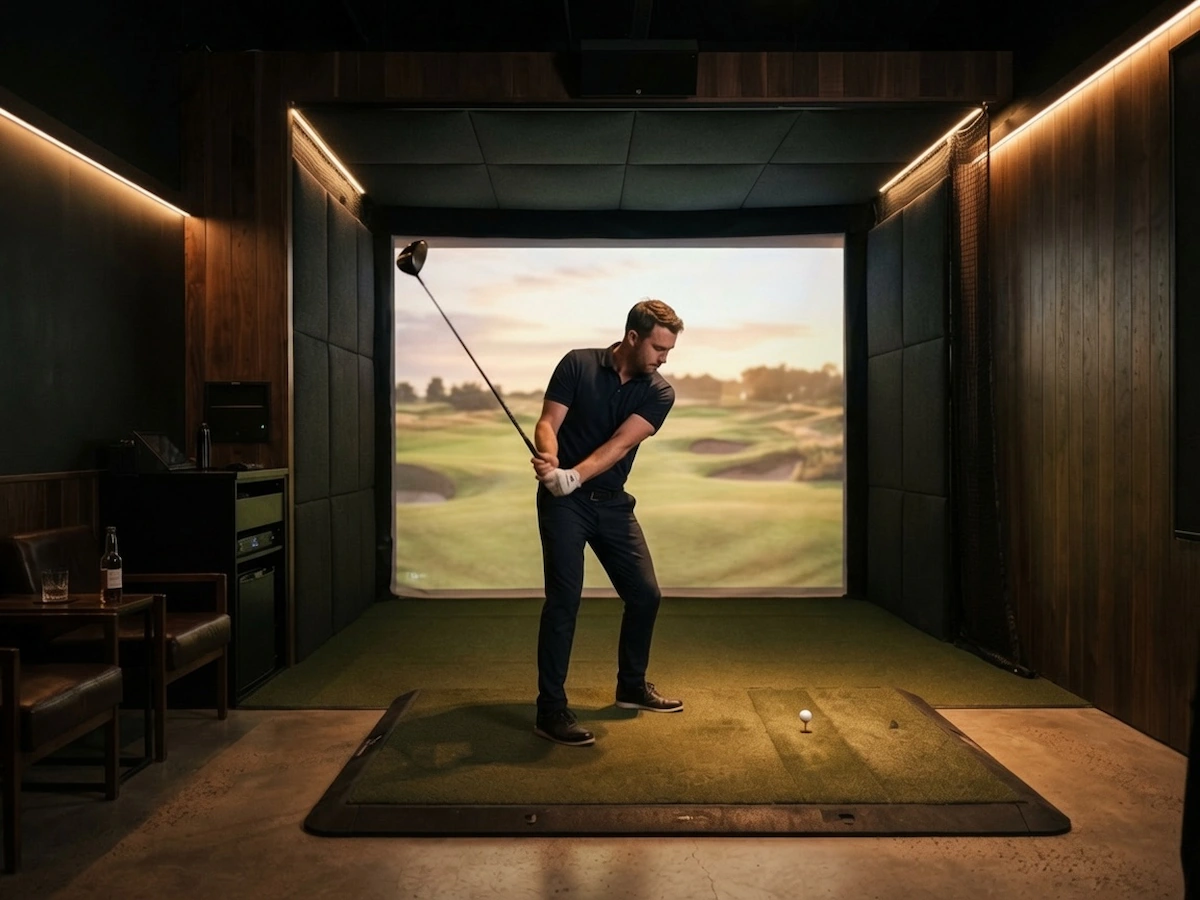
A commercial bay is rented by the hour. You book, hit into a screen, play a licensed course and leave. The technology is chosen for you, usually TrackMan, Uneekor, Foresight or a proprietary multi-camera system. Food, leagues and lessons are common. Nothing is yours afterwards except the scorecard.
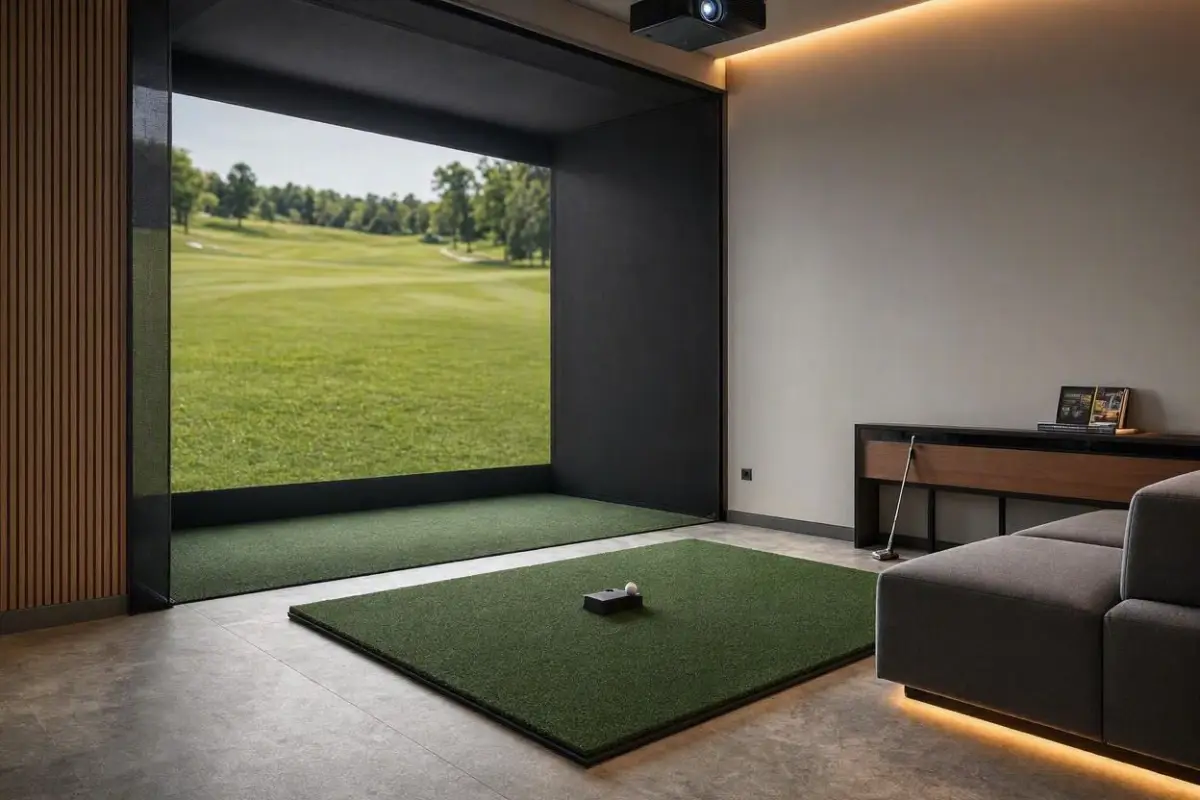
A home setup is a launch monitor, an impact surface, a display and course software in a garage, basement or spare room. You pick every part, you own the shot history, and after the build each extra round costs close to nothing. You also inherit every problem: ceiling height, projector throw, mat quality, and a Windows PC that has to keep working.
Both play a real 18 holes. If you are weighing the two, the deciding number is how many rounds a year you will actually play indoors. The arithmetic is further down this page.
How long does 18 holes take on a simulator?
Venues that sell bay time by the hour have every reason to publish an honest estimate, and they converge on the same rule. The Golf Garage in Minnesota states it plainly on its rates page: about one hour per person to play 18 holes. Use that as the planning figure when you book.
| Players | Booking guidance for 18 holes | What moves the number |
|---|---|---|
| 1 | 45 to 75 minutes | Shot-clock discipline, familiarity with the interface, how long you stare at the data |
| 2 | 1.5 to 2.5 hours | Shared turns, light conversation |
| 3 to 4 | 2.5 to 4 hours | Mulligans, practice swings, food and drinks |
| Range or practice only | 30 to 60 minutes | The most common short booking |
A recreational foursome outdoors commonly needs four to five hours. Indoors there is no walking, no ball hunting and no group waiting on the tee ahead of you. That is the whole time advantage, and it is the main reason people who own a setup end up playing more golf in winter than in summer.
What an indoor bay near you actually costs
Most published estimates for simulator bay time are too high, because they are written from the marketing pages of entertainment venues in large cities. The broadest count available says otherwise.
GolfSim.co’s State of Indoor Golf in America report, published in July 2026, tracks 3,849 live indoor golf venues across all 50 states. Of the 794 venues that publish an hourly rate, the median is $40 per bay hour. The middle half of those venues charge between $25 and $55. The national average climbs to $51 only because 44 venues charge $150 or more. The report also finds that more than 80% of American indoor golf venues are independents and that the typical facility runs four bays. By state, it puts South Carolina highest at a $90 median, followed by Nevada at $63 and Oklahoma at $58. The publisher extracts rates automatically from each venue’s own site, last checked 2 July 2026, and describes them as approximate.
That squares with the wider range MyGolfSpy reports, $20 to $80 per bay hour depending on facility type, city and time of day, along with the detail that matters most for groups: venues almost always price the bay rather than the player. A $60 bay split four ways is $15 each.
Franchise pricing sits above the national median. X Golf Schaumburg, to take one location publishing its own rates, lists $45 an hour on weekdays and $65 at weekends. Memberships change the picture again for anyone playing weekly.
So if you have read that indoor golf runs $40 to $90 an hour, that describes the upper half of the market. Budget the median and expect your own city to decide the rest.
How to vet a venue before you book
XS Golf does not maintain a venue directory and does not rank local facilities, so treat any “best near me” list, including the ones that rank well for the phrase, as an affiliate page rather than a survey. Search Google Maps or a directory such as GolfSim.co, then check these before you pay:
- Does the bay support full 18-hole course play, or only range and practice modes? Not every venue enables rounds on every bay.
- Which launch monitor, and is it the same model in every bay? Data quality varies more between systems than between venues.
- Per bay or per person, and does peak pricing apply to your slot?
- Course library. Ask which courses are actually installed, not how many the platform advertises.
- Left-handed support in the bay you are booking, if anyone in the group plays left-handed.
- Putting. Is there a putting surface, or does the software handle it?
- Clubs and balls. Rentals available, and can you bring your own ball, or does the system need a marked one?
- Booking minimum and cancellation policy, which is where an hourly rate quietly becomes a two-hour charge.
Our guide to booking simulator bays in 2026 covers the booking side in more detail, including how memberships and punch cards change the effective hourly rate.
Building a home setup that plays full rounds
Four parts, in the order they constrain each other: the room, the launch monitor, the impact surface and display, and the software.
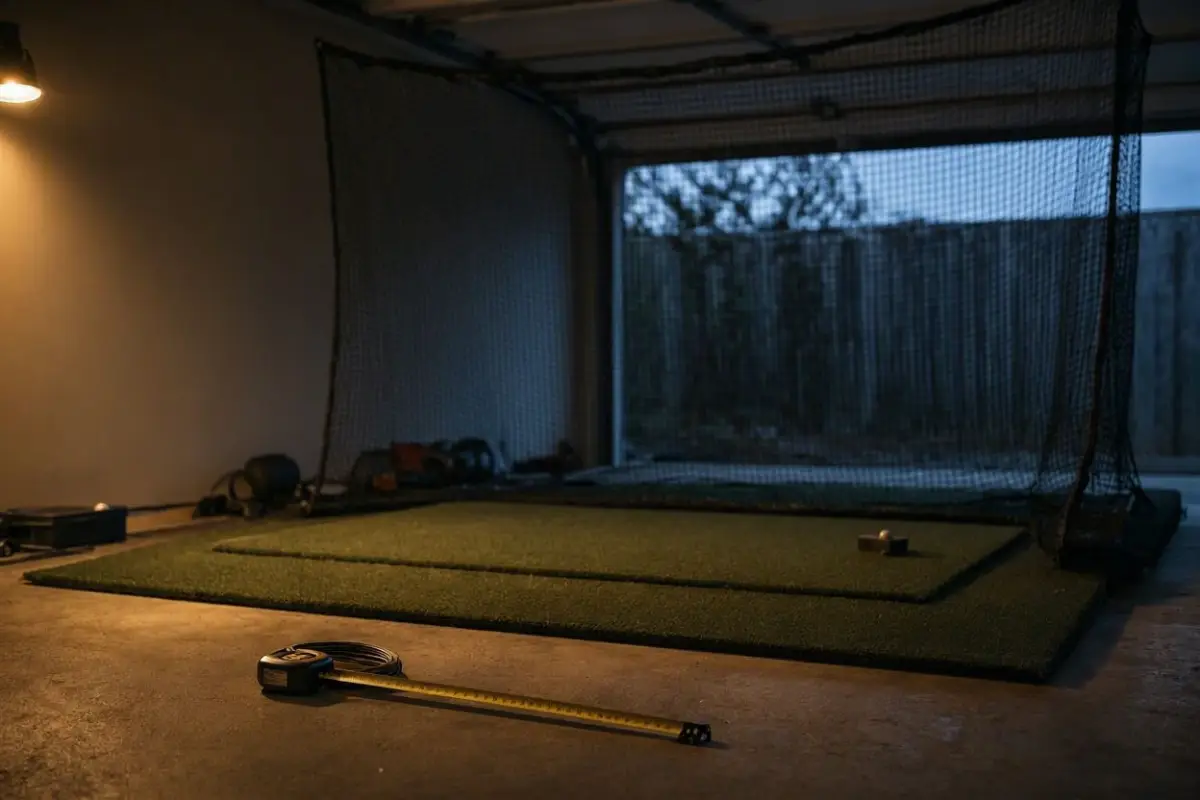
Measure the room first
Ceiling height is the most common reason a build fails, because it is the one dimension you cannot buy your way out of. The XS Golf standard across the site: 9 ft is the practical minimum for a full driver swing, 10 ft or more is what makes it comfortable. Below 9 ft most players shorten the swing without noticing, which makes the data worse than useless.
TrackMan’s own setup guidance is a useful upper reference. Its build guide says most golfers are comfortable starting around 10 ft of ceiling, 15 ft of width and 18 ft of depth, and that it recommends a 10 ft minimum ceiling. Those are comfort targets for a premium radar bay, not a floor for every system. TrackMan’s support documentation for the ceiling-mounted iO sets the hard numbers much lower: a minimum room height of 9 ft 4 in, an ideal mount height of 9 ft 8 in above the hitting surface, a minimum of 8 ft 2 in from tee to screen with 10 ft recommended, and a hitting area at least 6 ft deep by 5 ft wide.
The gap between those two sets of numbers is the whole point. Depth requirements belong to the technology, not to golf:
- Camera and photometric units sit beside or above the ball and measure at impact, so they work in shallower rooms.
- Radar units infer from ball flight and want distance behind and in front of the ball to do it reliably indoors.
- Overhead units clear the floor entirely and trade that for a ceiling-mount requirement.
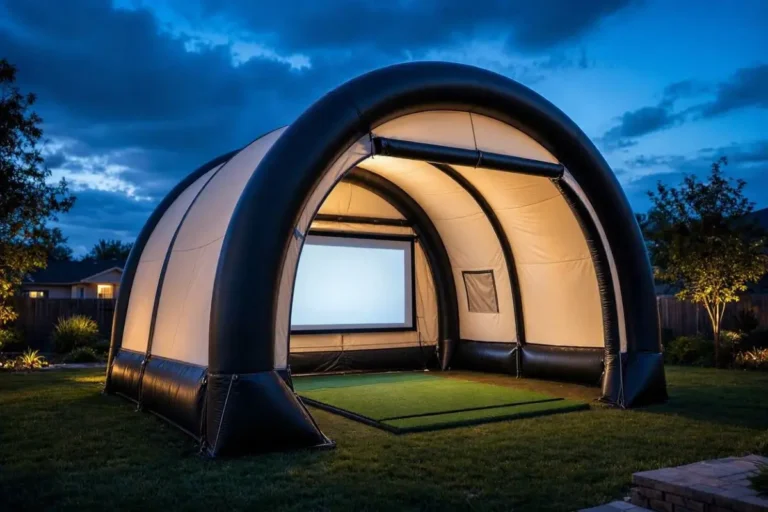
If the tape measure says the room is marginal, take your driver in there and make full swings at speed before buying anything. Our home golf simulator setup guide works through space, components and cost together, and simulator room ideas for 2026 covers layouts for awkward rooms. If the space genuinely will not clear, portable and inflatable setups are the fallback worth knowing about.
Pick the launch monitor to fit the room
Course play is more demanding than range practice, because every shot has a consequence. Errors compound across a round in a way they never do when you are hitting 40 seven-irons. What a full 18 needs from the hardware is consistency across clubs rather than a longer metric list.
Rather than repeat the comparisons, these are the pages that go device by device:
- Best golf launch monitors under $1,000 for the entry tier that still supports simulator play.
- Budget launch monitor shootout 2026 for what sub-$600 units measure and what they estimate, including the units that cannot run course software at all.
- SkyTrak MAX review and SkyTrak+ against SkyTrak MAX for the standard garage tier.
- Uneekor Eye Mini against SkyTrak and Mevo for tight rooms.
- TrackMan against SkyTrak MAX for what the money at the top actually buys.
- Best portable launch monitors and MLM2PRO against Mevo+ and the SC4 if the unit has to travel as well.
Budget the whole stack, not the monitor
The recurring mistake is spending the budget on the launch monitor and finishing the build with a thin mat and a borrowed projector. The mat matters for your wrists and elbows over a winter of indoor rounds, and the projector decides whether the room feels like golf.
Complete builds at each tier, with the parts matched to each other, are in best home golf simulators 2026. For specific price points, the garage build under $5,000 is the value bracket most 8 to 18 handicappers land in, and the $10,000 dedicated room covers the step up. Hidden costs and three-year ownership is the page to read before ordering, and accessories covers the parts people forget. The first-time buyer’s checklist lists the seven mistakes that show up most often, and installation covers the physical build.
Software: the part that decides whether you play 18 or just hit balls
The launch monitor measures. The software is what turns a measurement into a hole. Platforms that support full 18-hole rounds include GSPro, E6 by TruGolf, Foresight’s FSX, TrackMan Performance Studio and the native packages shipped with higher-end monitors.
Verified pricing, as published on 18 September 2026:
| Platform | Published price | Notes |
|---|---|---|
| GSPro | $250 per year | Annual licence, not a one-off. Windows only, needs a dedicated GPU. Connects to most major monitors through its open API. Community-built course library. |
| E6 by TruGolf | $300 or $600 per year | TruGolf’s E6 Connect page lists two annual tiers at $300 and $600. Its E6 (2026) page lists a Play tier at $300 and an Improve tier at $150. Confirm the current tier structure at purchase. TruGolf lists compatibility with 19 launch monitors, including the Garmin R10 and R50, Rapsodo and Square Golf. |
| Foresight FSX | Licence plus courses | Foresight sells courses individually and in bundles rather than as one subscription. Its software page lists a 27-course collection, with Creative Golf full library access adding over 100 more. Foresight’s Asia site states that an FSX 2020 licence includes 10 courses. |
| TrackMan Performance Studio | N/C for home pricing | TrackMan does not publish a standalone home software price in a form worth quoting. Its iO home package includes 60 courses per TrackMan’s own support documentation. |
A fuller platform comparison, including which monitors each one supports, is in best golf simulator software 2026.
Course counts are the least reliable number in indoor golf
Course library size is the headline figure venues and dealers advertise, and it is the figure least worth trusting. Checking each vendor against the pages selling its hardware on 18 September 2026 produced a consistent gap.
| Platform | What the vendor publishes | What resellers and venues advertise |
|---|---|---|
| TrackMan | Over 260 virtual courses, roughly three added a month, on TrackMan’s own simulator page. The iO home package includes 60. | 400 to 500 plus, on dealer, venue and directory pages |
| GSPro | Community-created library, counted differently by every seller | 300 plus, 500 plus, 1,000 plus and around 2,000, all published in 2026 |
| Foresight | No single headline count. A 27-course collection plus 100 plus through Creative Golf, courses sold individually | More than 300 |
Two practical conclusions. First, a number quoted by anyone selling the hardware is marketing until the vendor publishes it. Second, and more useful, the count barely matters. What matters is whether the ten courses you actually want to play are installed on the bay you are booking, or downloadable on the platform you are paying for. Ask that question instead.
Home or commercial: the arithmetic
Take a golfer playing two two-hour indoor sessions a month, which is 48 bay hours a year, and a $5,000 garage build with a $250 GSPro licence.
- At the $40 national median: $1,920 a year commercially. The home build breaks even in about three years, since $5,000 divided by ($1,920 minus $250) is 3.0.
- At $55, the top of the middle half: $2,640 a year. Break-even falls to about two years.
- A $1,500 budget build with a net instead of an enclosure breaks even against the median inside a year.
That is arithmetic, not a forecast. It ignores electricity, the PC, resale value, the fact that a lounge with a bar has a value of its own, and any membership rate that cuts the commercial side. It also ignores the strongest argument for owning one, which is that the marginal cost of a Tuesday-night nine holes is zero, so you play it.
Play fewer than ten indoor rounds a year and commercial bays win on every measure including hassle. Play weekly and the home setup pays for itself and keeps paying. Between those two, the deciding factor is usually whether you want the shot history.
What a full 18 needs to feel real
- Consistency across clubs. Carry, total, launch and spin that behave the same way on a 7-iron as on a driver. A unit that reads driver carry long by 5% will flatter you around a whole round.
- Club data, useful for diagnosis and close to irrelevant for fun. Face angle, path and impact location earn their keep in practice sessions, not on the 14th tee.
- Course rendering and pin positions, which is where licensed courses separate from generic layouts.
- Putting, the weakest link on nearly every consumer system and many commercial ones. Owner discussion consistently lands here, and it is a structural problem: systems built to measure a 100 mph driver strike are measuring a 4 mph putt with the same hardware. Many owners keep a separate putting mat and treat gimme settings as part of the game.
- Multiplayer and scoring modes, which is what turns a bay into a league night.
- Session history, the reason to own rather than rent if improvement is the point.
Once the room is built, the eight-week simulator practice program is the structure that stops it becoming an expensive way to hit driver. Two other uses worth knowing: playing a course on the simulator before a trip, and running the room as a home theatre when nobody is swinging.
Three questions, in order
- How many indoor rounds a year, honestly? Under ten, book bays. Weekly, build.
- Does the room clear 9 ft, and how much depth is there? The answer picks camera or radar, floor or overhead, before any brand enters the conversation.
- Do you want the data or just the round? Improvement work needs a permanent monitor and a session history. Entertainment does not.
How XS Golf evaluated this
XS Golf did not physically test the launch monitors, software or venues described on this page, and does not operate a testing facility. This guide was assembled from manufacturer and vendor documentation, operators’ own published rates, aggregate directory data and named third-party reporting, each cited at the claim it supports.
Sources used here: TrackMan for course counts and room dimensions, TruGolf for E6 pricing and compatibility, Foresight Sports for FSX software and courses, MyGolfSpy for bay pricing ranges, and GolfSim.co for the venue count and median rates. Where a figure could not be confirmed against a primary source it is marked N/C rather than estimated. Our editorial standards set out the method and its limits in full.
Frequently asked questions
How long does it take to play 18 holes on a golf simulator?
Plan about one hour per player. A solo round usually takes 45 to 75 minutes, two players 1.5 to 2.5 hours, and a foursome 2.5 to 4 hours depending on pace. These are the planning figures venues publish for bookings rather than measured session times.
Can you play a full 18 holes on a home golf simulator?
Yes. Any launch monitor that connects to course software such as GSPro, E6 by TruGolf or Foresight FSX will play complete 18-hole rounds with scoring, hazards and green play. The limits are the room and the software licence, not the concept. Some budget launch monitors do not support course software at all, so check that specifically before buying.
How much does an indoor golf simulator cost per hour near me?
The national median published rate in the United States is $40 per bay hour, and half of the venues that publish a rate charge between $25 and $55, according to GolfSim.co’s State of Indoor Golf in America report from July 2026. MyGolfSpy reports a wider $20 to $80 span depending on city, venue type and time of day. Most venues charge per bay rather than per player, so a group splits the cost.
What ceiling height do you need for an indoor golf simulator?
9 ft is the practical minimum for a full driver swing and 10 ft or more is recommended for a comfortable one. TrackMan recommends a 10 ft minimum ceiling in its own build guidance, while its ceiling-mounted iO documents a 9 ft 4 in minimum room height. Below 9 ft most players shorten the swing without realising it, which corrupts the data.
Is putting realistic on an indoor simulator?
It is the weakest part of most consumer and many commercial systems. Hardware built to measure a driver strike is measuring a putt with the same sensors, and short-game fidelity suffers. Many owners use the simulator for full shots and keep a separate putting mat, or play with gimme circles enabled.
How many courses can you actually play?
Fewer than the marketing suggests, and the number depends on the vendor rather than the reseller. TrackMan’s own simulator page lists over 260 virtual courses and its iO home package includes 60, while dealer and venue pages routinely advertise 400 to 500 plus. GSPro’s community library is quoted anywhere from 300 to about 2,000 depending on the seller. What matters is whether the specific courses you want are installed or downloadable.
Do commercial simulators need special balls or clubs?
Most venues supply balls and encourage you to bring your own clubs. Some camera-based systems read a marked or RCT-style ball more reliably, so ask when booking. Home optical systems generally work with standard premium balls.
Related reading
- Best home golf simulators 2026: complete setups for every budget
- Best home golf simulators 2026
- Home golf simulator setup guide: space, cost, software
- Golf simulator build guide 2026: the $5,000 garage setup
- Best golf simulator software 2026
- Hidden costs: the three-year cost of owning a simulator
- Best golf launch monitors under $1,000
- Simulator brands and auto-tee systems compared
- How to book simulator bays in 2026