Portable Golf Simulator Setups: The Best Inflatable Options for Home, Travel, and Events
Last updated: September 19, 2026
Disclosure: some links on this page are affiliate links. XS Golf may earn a commission if you buy through them, at no extra cost to you.
Every home simulator guide on this site opens with the same problem: you need a room. Nine feet of ceiling, twelve feet of width, fifteen feet of depth, and a willingness to give that space up permanently. That requirement is why most people who want a simulator never build one.
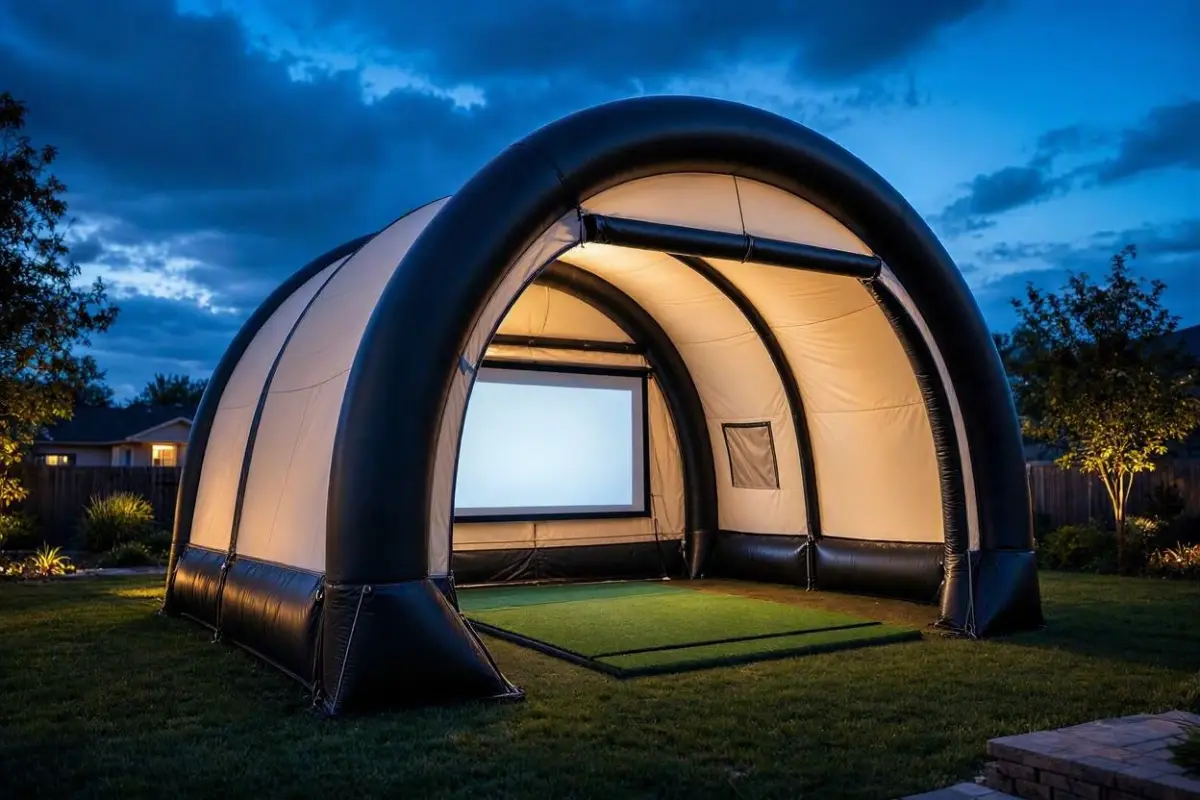
Inflatable enclosures are the category that tries to answer it. They are air-beam structures made from PVC tarpaulin or Oxford fabric, they inflate from a pump in about five minutes, and they fold into a bag when you are finished. Garage, driveway, backyard, event lot. No framing, no drilling, no room lost for good.
The category is real and some of it is good. It is also full of products that are sold as simulator enclosures and are not big enough to be one. This guide separates the two, using published manufacturer dimensions checked in September 2026 and the same space minimums we apply to every permanent build.
Quick Verdict
Only the larger commercial units are actually simulator enclosures. The cheap ones are hitting bays with a screen in them.
Our published minimum for a working simulator is a 9 ft ceiling, 12 ft of width and 15 ft of depth. Measure the inflatable options against that and the category splits cleanly in two.
- Best all-round portable simulator — All Sports Inflatables 12×16 ($2,999): 12 ft wide, 16 ft deep, 10 ft high outside. The cheapest unit we found that clears every one of our minimums. Offset hitting mat required, one person inside at a time.
- Best for two-handed households or events — All Sports Inflatables 16×16 ($4,999): the extra four feet of width is what lets a left- and right-hander share a centre mat without moving hardware.
- Best cheap backyard hitting bay — FunJain Pro Series ($1,299): 13.1 ft wide but only 9.8 ft deep. Good PVC, sealed-air, five-minute setup. Too shallow for a real simulator build regardless of what the launch monitor compatibility list says.
- Skip for simulator use — FunJain Lite Edition ($699): 9.8 × 8.9 × 8.9 ft and a blower that has to run the whole time. Under our minimum on all three axes.
- The honest caveat: every figure above is an outside dimension. Inflated tube walls eat into it, and no manufacturer in this category publishes the usable interior.
Prices and specifications checked against manufacturer product pages on 15 September 2026. This category moves fast; confirm before you buy.
The measurement that decides everything
Our home simulator setup guide publishes the space table we hold every build to: 9 ft of ceiling as the practical minimum and 10 ft or more recommended, 12 ft of width for an offset mat and 15 ft or more for a centred one, 15 ft of depth minimum and 18 to 20 ft recommended. Those are not aspirational numbers. They come from what a driver swing and a launch monitor physically need.
Depth is the one people underestimate, and it is the one inflatables most often fail. You need room behind the ball for a radar unit to see the strike, room in front of the ball so the screen is far enough away that the projected image is not distorted and the ball is not rebounding into your shins, and room to stand. A tent that is under ten feet front to back does not have that. It has space for a ball, a mat and a screen about seven feet away.
That does not make a shallow tent useless. It makes it a hitting bay: a safe, dark place to hit into a screen with an optical launch monitor that sits beside the ball. It is not the thing you play virtual Pebble Beach in. The vendors in this category are not always careful about the difference, so we are.
One more measurement caveat that applies to the whole category. Every dimension published by these manufacturers is external. The inflated beams that hold the structure up are thick, so the space you can actually swing in is smaller than the number on the product page. None of the vendors we checked publishes an internal figure, so we have marked it N/C throughout rather than estimating.
Sealed air or continuous blower
This is the second spec that matters and the one most buyers do not think about until the thing is running.
Sealed air means you inflate the beams once with a high-pressure pump, close the valve, and the structure stands on its own. The pump comes off. No noise, no power draw, nothing to trip over. All Sports Inflatables and the FunJain Pro Series both work this way.
Continuous airflow means a blower runs the entire time you are using it, the way a bouncy castle does. It is cheaper to build and lighter to carry. It also means a fan is running three feet from you while you try to hear contact, and the structure sags the moment power drops. FunJain’s Lite Edition states plainly that the blower must remain on during use. That is not a defect, it is the design, but it is worth knowing before you buy the cheaper one to use in a garage at eleven at night.
All Sports Inflatables: the line that clears our minimums
All Sports Inflatables is a Houston, Texas manufacturer selling commercial-grade inflatable enclosures for golf, baseball and multi-sport use. It is the most expensive option here and the only one whose smallest golf enclosure meets every space figure we publish.
The current golf range and list prices, taken from the manufacturer’s own store on 15 September 2026:
| Model | Outside dimensions | Price | Notes |
|---|---|---|---|
| 12×16 | 12 ft W × 16 ft D × 10 ft H | $2,999 | Offset hitting mat required; one person inside |
| 16×16 | 16 ft W × 16 ft D × 10 ft H | $4,999 | Centre mat possible; one person inside |
| 16×20 | 16 ft W × 20 ft D | $5,999 | Depth allows spectators behind the golfer; heavy, needs help to move |
| 18×30 | 18 ft W × 30 ft D | $9,999 | Largest in the range |
| Hitting Bay 10×6 | 10 ft × 6 ft | $2,499 | Practice bay, not a simulator enclosure |
| Hitting Cage 12×20 | 12 ft × 20 ft | $2,999 | Cage rather than blackout enclosure |
The specification list is the reason for the price. Commercial-grade PVC tarpaulin frame, a blackout cover with water-resistant coating, interior side-wall netting throughout, a rear impact net, two side windows for ventilation or spectators, twelve exterior D-rings for anchoring and three interior D-rings for lights, and an 800-watt electric pump included. The impact screen is included and attaches with heavy-duty Velcro.
Two details are worth pulling out. The impact screen is forward-shifted, which removes the bottom horizontal crossmember from behind it, and the manufacturer states this reduces ball rebound. Anyone who has taken a ball back off a tight screen understands why that matters. Second, the roof is offered flat, peaked or arched, and there is an optional sun visor and front curtain for outdoor use.
What is not included: artificial turf, hitting mat, projector enclosure and sandbags. Those are sold as add-ons and we have priced them below, because they are the difference between the sticker price and what you actually spend.
The 12×16 at $2,999 is the interesting one. It is the cheapest enclosure we found at any price that gives you 16 ft of depth and a 10 ft ceiling. If you are choosing between this and a permanent build, our garage simulator guide under $5,000 and the three-year cost of ownership breakdown are the two pages that will tell you whether portability is worth the premium in your situation.
FunJain Pro Series: good build, wrong shape
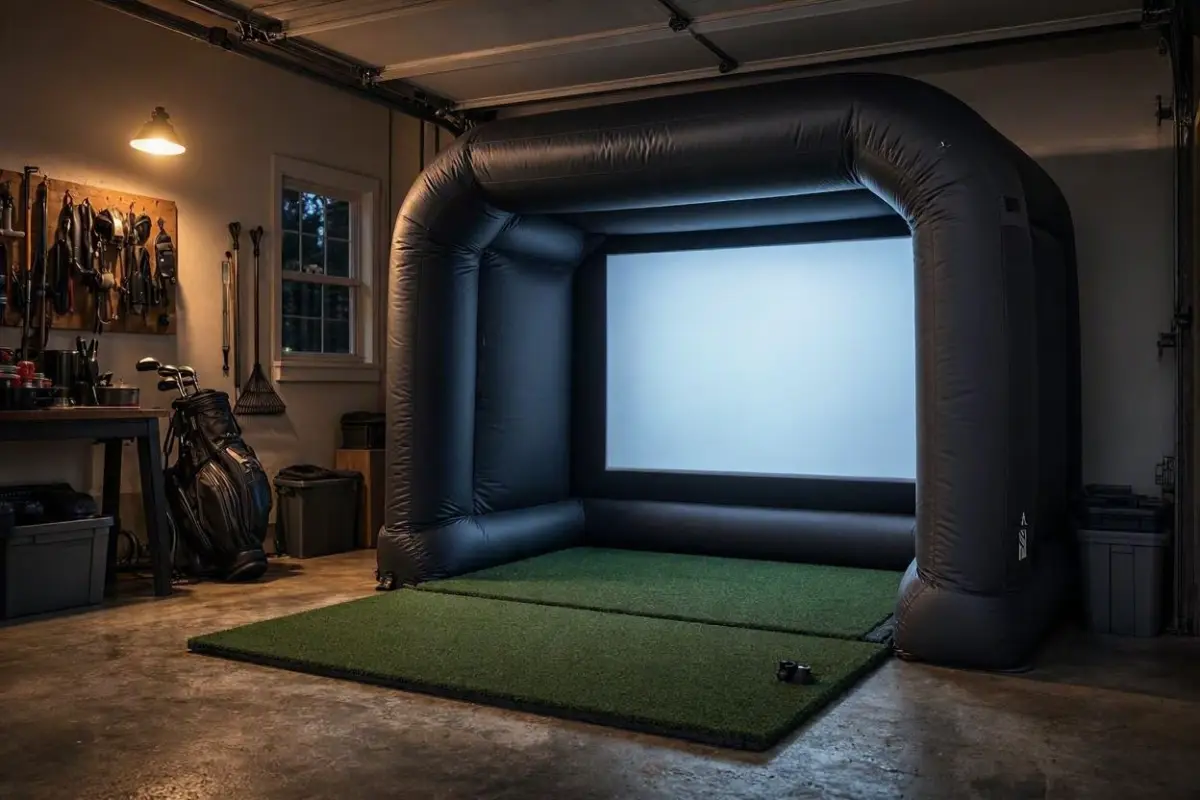
FunJain (the same product also appears as the Jain Pro tent) sells a PVC sealed-air enclosure at $1,299, marked down from a $1,500 list. It is the unit most people find first when they search for an inflatable golf simulator, and on materials it deserves the attention: reinforced industrial PVC, a detachable HD impact screen, a high-pressure electric pump, ground stakes and a tie-down rope kit, a carry bag and a repair kit, and a 12-month warranty with a 30-day money-back guarantee.
The published dimensions are 13.1 ft wide × 9.8 ft deep × 9.8 ft high, or roughly 4 × 3 × 3 metres. FunJain’s own product page states a minimum recommended space of 10 × 10 ft and suggests 13 × 10 ft or larger.
Width is fine. Height is marginal: 9.8 ft outside clears our 9 ft minimum but misses the 10 ft we recommend, and the usable interior is lower than 9.8 ft by an amount the manufacturer does not publish. If you are tall or you swing a long driver, measure before you order.
Depth is the problem. At 9.8 ft it is a third short of our 15 ft minimum. The product page lists compatibility with the Garmin Approach R10, SkyTrak, Mevo+ and Trackman, and in the narrow sense that is true — those units will pair and produce numbers inside it. But a rear-facing radar unit needs distance behind the ball to read the strike, and ten feet of total depth does not leave it. If you want radar numbers you can trust, our launch monitors under $1,000 guide and the MLM2PRO, Mevo+ and SC4 comparison both cover which units need depth and which do not.
Bought as what it physically is — a portable, blacked-out, weather-resistant hitting bay with a projection screen for around $1,300 — the Pro Series is a reasonable product. Bought as a simulator enclosure because the listing says simulator, it will disappoint.
FunJain Lite Edition: a practice tent, not a simulator
The Lite or Oxford Edition is $699, down from $799. High-density Oxford cloth rather than PVC, continuous airflow rather than sealed air, and dimensions of 9.8 ft wide × 8.9 ft deep × 8.9 ft high. It ships with a detachable HD impact screen, the blower, stakes and tie-down ropes, a carry bag and a patch kit, under the same 12-month warranty.
It is under our published minimum on all three axes, and 8.9 ft of external height means the interior is below the 9 ft floor we treat as the point where a driver swing stops being safe. We would not describe this as a golf simulator enclosure. As a portable, packable net-and-screen bay for iron work in a backyard, at $699 with a blower and a screen included, it is priced about right for what it is.
Golf GPD “The All Weather”: the premium end
At the top of the category sits Golf GPD’s All Weather enclosure, a US-made unit measuring roughly 26 ft long × 16 ft wide × 13 ft high. Golf Simulator Advisor, which ranks it as its top inflatable pick, reports a price of around $12,550 plus tax and shipping, notes that setup takes two people, and says it accommodates up to eight.
We were not able to confirm that price on the manufacturer’s own site, so treat it as N/C and quote it back to Golf GPD rather than relying on it. On dimensions alone it is the only inflatable here that reaches the 10 to 13 ft height and 18 ft-plus depth that our setup guide lists as the comfortable sweet spot. At that budget you are also in range of a permanent build, so the case for it rests entirely on needing to move it.
Marketplace units: Temu, eBay and Amazon
Below the branded tier there is a large supply of factory-direct inflatable enclosures sold through Temu, eBay, Amazon and Alibaba. Factory-direct eBay listings checked on 15 September 2026 ran from roughly $850 for a 6 × 10 × 10 ft hitting bay to around $2,150 for units in the 13 to 15 ft range, typically specified as 0.55 mm commercial PVC with a blower included and shipped from China. We did not verify Temu pricing at source and are not quoting a figure for it.
Several of those listings are plausibly the same factory output that reaches buyers under a Western brand name at three times the price. Some of them are not. The reason we are not ranking specific marketplace units is that the things that separate a good one from a bad one — seam construction, screen density, UV stability of the fabric, whether the seller honours a warranty in your country — are exactly the things a listing will not tell you and we have no way to check.
If you buy at this tier, buy it as an experiment. Check the return policy before the price, assume the assembly instructions will be poor, and do not plan a full-driver practice routine around it until it has survived a few months. The category-level risks are real: UV degradation outdoors, abrasion and punctures, and rebound behaviour that varies a lot by screen quality.
Quick comparison
| Feature | ASI 12×16 | ASI 16×16 | FunJain Pro | FunJain Lite |
|---|---|---|---|---|
| Price | $2,999 | $4,999 | $1,299 | $699 |
| Width (outside) | 12 ft | 16 ft | 13.1 ft | 9.8 ft |
| Depth (outside) | 16 ft | 16 ft | 9.8 ft | 8.9 ft |
| Height (outside) | 10 ft | 10 ft | 9.8 ft | 8.9 ft |
| Usable interior | N/C | N/C | N/C | N/C |
| Meets our 9/12/15 minimum | Yes | Yes | No (depth) | No (all three) |
| Inflation | Sealed air, 800 W pump | Sealed air, 800 W pump | Sealed air, high-pressure pump | Continuous blower, runs during use |
| Material | Commercial PVC tarpaulin | Commercial PVC tarpaulin | Reinforced industrial PVC | High-density Oxford cloth |
| Screen included | Yes | Yes | Yes, detachable | Yes, detachable |
| Side netting | Yes, integrated | Yes, integrated | N/C | N/C |
| Anchoring | 12 exterior D-rings | 12 exterior D-rings | Stakes and ropes | Stakes and ropes |
| Warranty | N/C | N/C | 12 months | 12 months |
All figures are from manufacturer product pages, checked 15 September 2026. N/C means we could not confirm the figure from a primary source and have not estimated it.
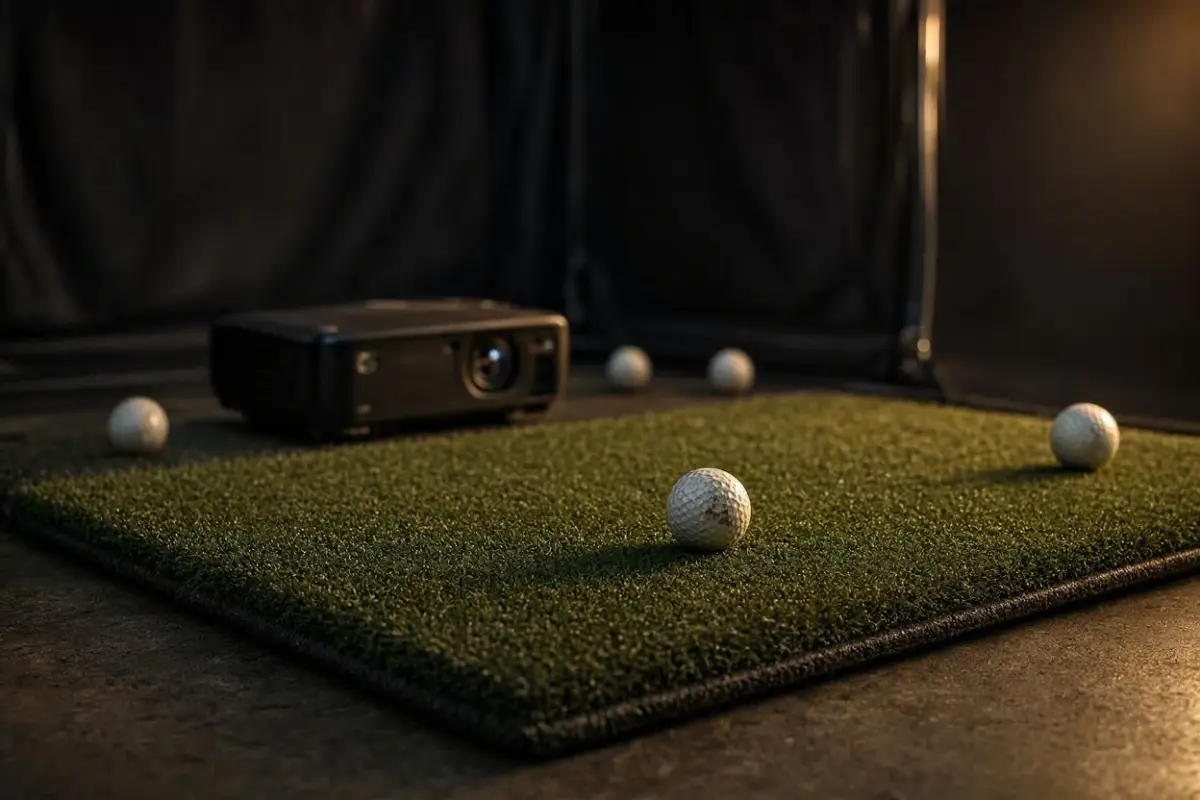
What the enclosure does not include
An enclosure is a room, not a simulator. The single most common budgeting mistake in this category is treating the tent price as the project price. All Sports Inflatables publishes its add-on pricing, which makes the real number easy to see:
| Add-on | ASI list price |
|---|---|
| 5 × 5 ft hitting mat | $599 |
| 5 × 10 ft hitting mat | $1,199 |
| Heavy-duty sandbags (set of 6) | $150 |
| Floor projector enclosure | $299 |
| Laptop and launch monitor cabinet | $399 |
| Overhead projector tube clip | $150 |
| Golf cable pack | $150 |
| PVC patch kit | $65 |
Add a projector, a launch monitor and software on top of that and a $2,999 enclosure becomes a five-figure project quickly. Our simulator build guide walks the whole component list, the software guide covers what GSPro and E6 Connect actually cost per year, and the accessories guide covers mats, nets and cabling.
One component deserves more of your budget than most people give it. A thin mat bottoms out on iron shots, wears through quickly, and changes how the club interacts with the surface. Spend there before you spend on the last increment of launch monitor accuracy.
Outdoor use is the selling point and the complication
The reason to buy inflatable rather than framed is that you can put it on grass. That brings three things a permanent room never has to deal with.
Anchoring. An inflated enclosure is a large, light, hollow object. It needs stakes on grass or ballast on concrete, and it needs them every time, not just on windy days. ASI’s twelve exterior D-rings and its $150 sandbag set exist for this reason. FunJain ships stakes and ropes with both units.
Light. Blackout fabric is what makes a projected image watchable outdoors, and it is the single biggest quality difference between a commercial enclosure and a cheap one. Even with good fabric, daytime outdoor use pushes you toward a brighter projector than you would need indoors.
What sunlight does to your data. Camera-based, optical launch monitors read the ball and club at impact, and shifting shadows or direct sun across the hitting area can interfere with that. Radar units are less bothered by light. This is worth thinking through before you pick a unit for an outdoor tent, and our portable launch monitor guide and the budget shootout both cover the radar-versus-optical trade-off in detail.
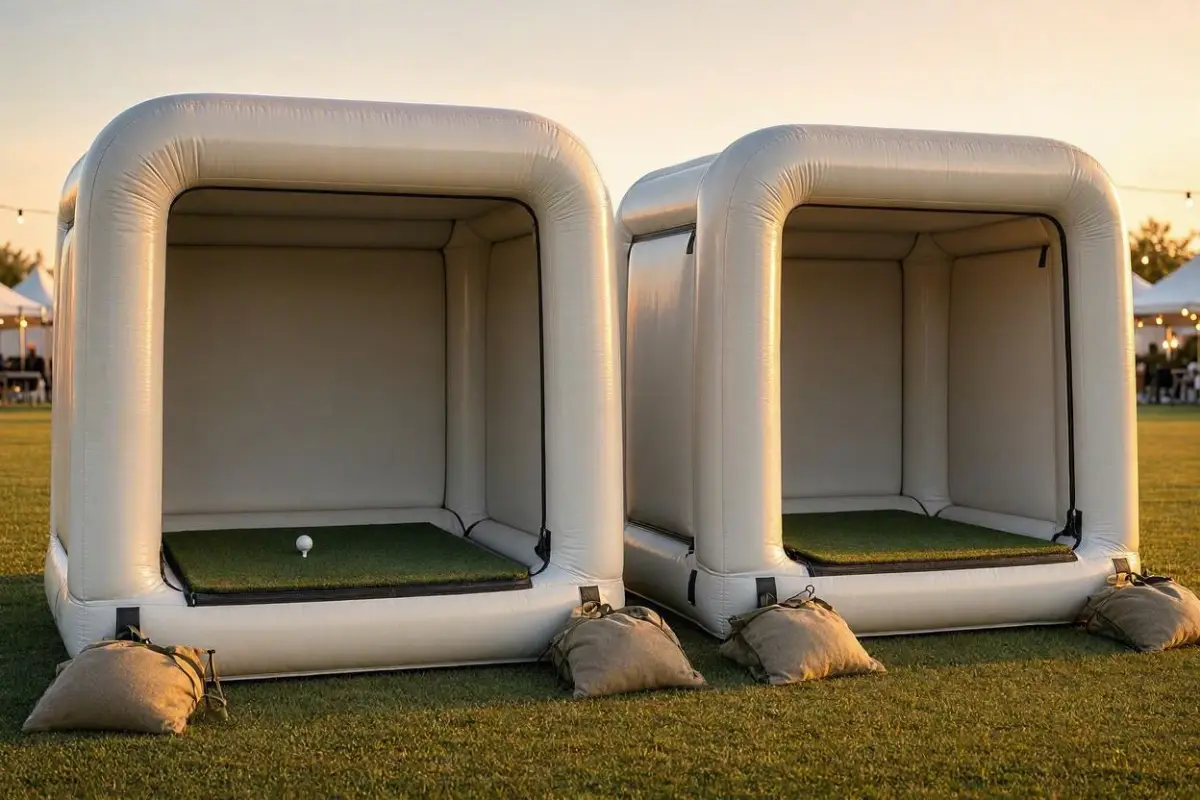
Who each setup actually suits
Home, but you cannot give up the room. Renters, shared garages, a space that has to be a garage again on Monday. The ASI 12×16 at $2,999 is the entry point that does not compromise the swing. Below that, you are buying a hitting bay and should plan accordingly. If your situation is actually “I have a garage and can leave things in it”, read the garage build guide first — a framed enclosure is usually cheaper and better for a space you control.
Travel. Realistically this means a second property, a long trip by car, or a seasonal setup you strike at the end of summer. Packed weight and bulk are not trivial on the larger units — ASI says outright that the 16×20 needs help to move. A bag you can lift alone means the FunJain tier, and the FunJain tier means a hitting bay. If travel practice is the goal rather than travel simulation, a portable launch monitor and a net is a smaller, cheaper answer.
Events and mobile businesses. This is where the category makes the most sense, and it is who the commercial units are built for. Fast deployment, a professional look, logo printing, spectator windows, and a structure that packs into a van. ASI sells a guide to starting a mobile rental business alongside the enclosures, which tells you where the demand is. If you are running a bay commercially, our guide to booking simulator bays covers what customers expect from the other side of the counter.
For context on why this market exists at all: the National Golf Foundation reported that 48.1 million Americans aged 6 and over played golf on or off a course in 2025, an all-time high, with 19 million of those participating exclusively away from a golf course. NGF has separately reported that the simulator and screen golf participant base has more than doubled since 2019, when it sat just under 4 million.
How we evaluated these enclosures
XS Golf did not physically test these enclosures. This guide is built from manufacturer product pages and specification sheets, published retail pricing, and third-party reporting, each attributed where it is used.
Every dimension and price above was read directly from the manufacturer’s own store page on 15 September 2026, except the Golf GPD price, which comes from Golf Simulator Advisor and is marked N/C because we could not confirm it at source. Where a manufacturer does not publish a figure — usable interior dimensions, warranty terms on the ASI range, side netting on the FunJain units — we have marked it N/C rather than filling the gap with an estimate.
The pass/fail judgements in the comparison table are arithmetic, not opinion: they compare each manufacturer’s published external dimensions against the space minimums already published in our setup guide. Read our editorial standards for how we handle claims we cannot verify.
Frequently asked questions
Can you really use an inflatable golf simulator enclosure outdoors?
Yes, and that is the main reason to buy one. Every unit covered here is specified for indoor or outdoor use. The conditions are that you anchor it properly every single time, that the fabric is genuinely blackout if you want a watchable projected image in daylight, and that you accept UV exposure will age the material faster than indoor use would.
What ceiling height do I need for an inflatable enclosure?
The same as any simulator: 9 ft is our practical minimum and 10 ft or more is what we recommend. The catch is that inflatable manufacturers publish external heights, so a tent listed at 9.8 ft gives you less than 9.8 ft inside. None of them publishes the internal figure, so if you are near the limit, ask the vendor before ordering.
Is a $699 inflatable enclosure a real golf simulator?
No. At that price you are buying a portable hitting bay with an impact screen — a good thing to own, but not the same thing. FunJain’s Lite Edition measures 9.8 × 8.9 × 8.9 ft externally, which is below our minimum on width, depth and height. Treat it as a net replacement with better light control.
Sealed air or continuous blower — which should I choose?
Sealed air if you can afford it. You inflate once, close the valve and the pump comes off, so there is no fan noise and no continuous power draw. Continuous blower units are cheaper and lighter but the blower has to run the whole time you are hitting, which is a real annoyance indoors and at night.
Will my Garmin R10 work inside an inflatable tent?
It will pair and produce numbers in almost any of them. Whether those numbers are worth much depends on depth: rear-facing radar units need distance behind the ball, and most of the sub-$1,500 inflatables are under ten feet deep in total. An optical unit that sits beside the ball is the better match for a shallow tent.
How long does an inflatable golf enclosure last?
We do not have verified longevity data for any unit in this category and will not estimate it. What is known is that the variables are material grade, UV exposure, and how it is handled during setup and takedown. Commercial-grade PVC tarpaulin is built for repeated deployment in a way that lighter Oxford fabric is not. Buy a patch kit either way.
Where to buy
All Sports Inflatables, FunJain and Golf GPD all sell direct rather than through Amazon, so buy those from the manufacturer. For the marketplace tier, these searches show current listings — we have not verified any individual seller or unit, and nothing in this section is a recommendation of a specific product:
- Inflatable golf simulator enclosures on Amazon US
- Inflatable golf simulator enclosures on Amazon UK
- Golf simulator hitting mats on Amazon US
- Golf simulator hitting mats on Amazon UK
XS Golf is an Amazon Associate and earns from qualifying purchases made through the links above, at no extra cost to you. Affiliate income never determines what we recommend or how we rate a product. See our affiliate disclosure for the full policy.
Related reading
- → Home Golf Simulator Setup Guide: Space, Dimensions and Layout
- → Best Home Golf Simulators 2026
- → Best Garage Golf Simulator Under $5,000
- → Golf Simulator Build Guide 2026
- → How to Install a Golf Simulator
- → Hidden Costs: the Three-Year Cost of Ownership
- → Best Golf Simulator Software 2026
- → Best Portable Launch Monitors 2026
- → First-Time Simulator Buyer’s Checklist
- → Golf Simulator Room Ideas 2026
- → I Have a Golf Simulator. Now What?
- → Simulator as Family Home Theater