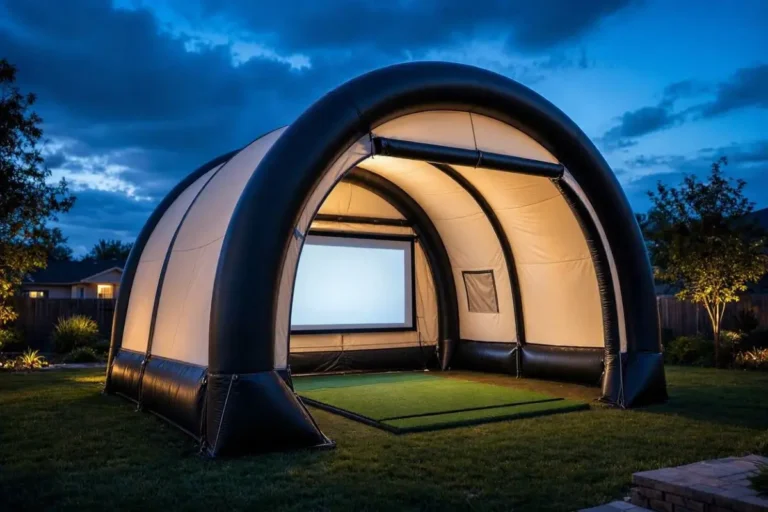
The $10,000 Golf Simulator: A Pro-Level Home Setup
Last updated: September 18, 2026
The $5,000 garage simulator is the smartest entry point. But if you have a dedicated space, a serious practice habit, and a budget that stretches to $10,000, a different tier of equipment opens up — and the performance gap is significant.
This is the build we would choose if money was not the primary constraint. Every component is chosen for longevity, accuracy, and daily-use reliability.
The $10,000 Build: Component Breakdown
1. Launch Monitor: Bushnell Launch Pro — $2,999
The Bushnell Launch Pro is essentially an orange Foresight GC3, according to Plugged In Golf. It launched at $2,499 in November 2025 (Bushnell’s launch announcement), and authorized retailers PlayBetter and Top Shelf Golf list it at $2,999 (price verified: 18 September 2026). An earlier version of this build listed it at $999, which was wrong.
Ball data works out of the box. Club data and simulator software need a subscription, so this build adds Bushnell’s Silver plan (see item 7). We have not found a published test that puts a number on its accuracy against TrackMan, so we don’t quote one.
2. Enclosure: Carl’s Place Pro Studio Kit — $1,699
The Pro Studio Kit is Carl’s answer to permanent installations. The frame is thicker-gauged steel, designed to be wall-mounted or free-standing for decades rather than years. The impact screen is the HD Pro — a step above the standard DIY screen, with better image quality and a stiffer weave that reduces bounce-back at driver speeds.
At this tier, the enclosure should disappear into the room. The Carl’s Place Pro does that. Pair it with proper side and ceiling baffles ($299 additional) to eliminate ball escape entirely.
3. Projector: Optoma UHD38 4K — $999
4K projection changes the simulator experience in ways that are hard to overstate until you see it. The Optoma UHD38 delivers 4,000 lumens, true 4K resolution, and a 0.47:1 throw ratio — close-mount capable. On a 12-foot-wide impact screen, the image quality rivals a commercial golf center installation.
The upgrade from 1080p to 4K is most visible on the green and fairway textures in the Foresight FSX cour $5,000 garage simulator build guidese library. Pin positions are immediately readable at distance. Ball flight tracking on screen is noticeably smoother.
4. Hitting Mat: Fiberbuilt Flight Deck 7×7 — $899
At the $10,000 tier, the hitting mat deserves a serious upgrade. The Fiberbuilt Flight Deck is the professional standard — used in Tour vans and commercial fitting bays. The 7×7 size gives left-handed players proper room on both sides, and the dual-surface (fairway and rough) is genuinely different from synthetic mats.
More importantly, the Flight Deck’s fiber-tuft construction means proper divot feedback. You will develop a real feel for ball-first contact rather than the scooping habit that rubber mats can reinforce.
5. Room Treatment: Acoustic Panels + Dedicated Circuit — $800
A $10,000 simulator in a room that sounds like a tin shed is a missed opportunity. Four 2×4 acoustic panels on the side walls reduce the impact echo dramatically. More practically: a dedicated 20-amp circuit for the projector and launch monitor prevents power-draw fluctuations from affecting device performance or creating surge risk.
6. Putting Green: SYNLawn Golf Pro Series 9×12 — $1,800
A dedicated putting green inside the simulator room separates a serious practice setup from a casual one. The SYNLawn Golf Pro Series uses variable-speed inserts to replicate different green speeds — Tour-speed is 11–12 on the Stimpmeter, while the standard insert runs at 9–10 for more forgiving practice.
Putting is the fastest way to reduce your score. Having a green steps from the simulator means every session can end with 15 minutes of meaningful putting practice.
7. Bushnell Silver subscription (2 years) — $398
Silver costs $199 a year and covers club data, performance analysis and simulator play, according to Bushnell’s launch announcement. Gold, at $499 a year, adds 20 courses and GSPro compatibility; GSPro itself is a separate subscription. Over two years, Silver works out at about $17 a month.
Total Cost Breakdown
| Component | Item | Price |
|---|---|---|
| Launch Monitor | Bushnell Launch Pro | $2,999 |
| Enclosure | Carl’s Place Pro Studio | $1,699 |
| Side/Ceiling Baffles | Carl’s Place add-on | $299 |
| Projector | Optoma UHD38 4K | $999 |
| Hitting Mat | Fiberbuilt Flight Deck 7×7 | $899 |
| Room Treatment | Acoustic panels + circuit | $800 |
| Putting Green | SYNLawn Golf Pro 9×12 | $1,800 |
| Software | Bushnell Silver subscription (2yr) | $398 |
| Total | $9,893 |
Upfront cost is only part of the story. At this tier, launch monitor subscriptions, software, and maintenance keep adding up year after year. See the full 3-year total cost of ownership breakdown.
That leaves about $100 of a $10,000 budget. The extras (a ceiling-mounted projector arm around $150, a dedicated iPad for the software around $800, and the dedicated electrical circuit around $350) take the full build to roughly $11,200. To stay under $10,000, consider the indoor-only Bushnell LPi, which launched at $1,499 per Bushnell; check its current price before buying.
Is It Worth $10,000?
A country club membership in the US averages $8,000–$12,000 per year. A $10,000 simulator amortised over 10 years is $1,000/year — and it is in your home, available at 6am or 11pm, regardless of weather. If you play more than 20 rounds a year, the maths work in the simulator’s favour within 3–4 years.
If $10,000 is too much, start with our $5,000 build guide. The SkyTrak MAX at that tier delivers 80% of this setup’s practice value at half the cost.
Some links on XS Golf are affiliate links. See our affiliate disclosure.