Best Home Golf Simulators 2026: From Budget Garages to Luxury Studios
Published: June 3, 2026 · Last updated: November 14, 2026
Prices verified: October–November 2026.
Quick answer
There is no single best home golf simulator in 2026
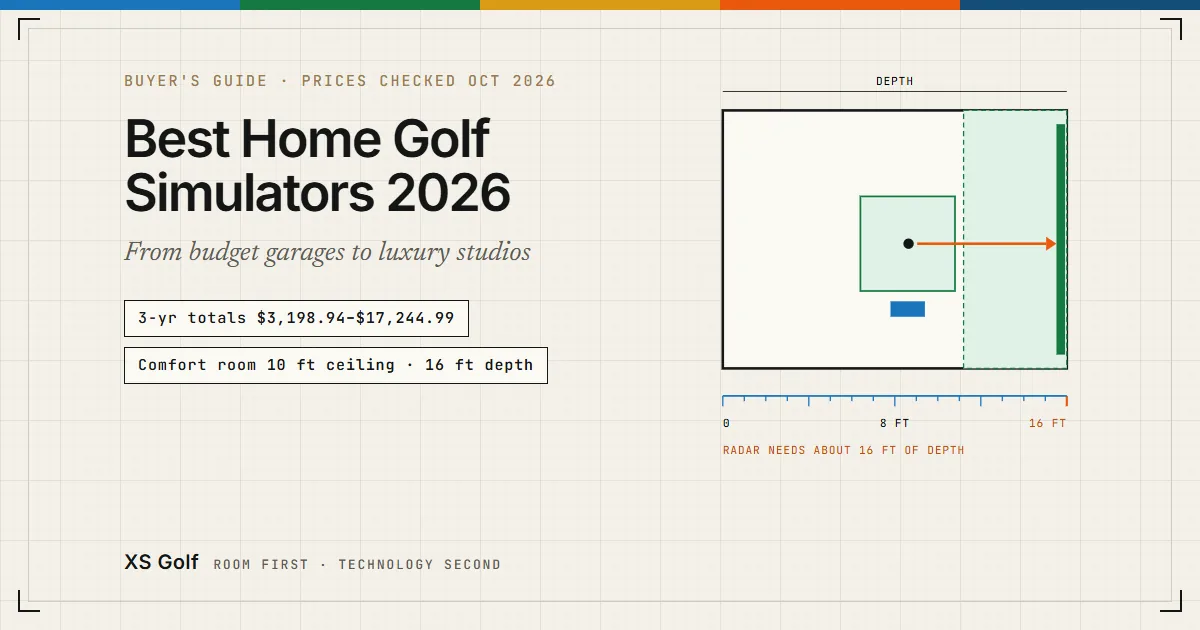
Room depth and three-year total cost of ownership decide the right home simulator before any spec sheet does. Across five priced reference setups, three-year totals run from $3,198.94 (a Garmin R10 DIY build) to $14,244.99 (a Uneekor EYE XO2 studio). Camera units suit tight rooms; radar needs about 16 ft of depth. Nothing here was physically tested.
- Tight spaces: go optical. A camera unit beside the ball needs nothing behind it, so its own footprint is small (PlayBetter lists about 10 ft of depth for Square Golf), but that is the device, not a room for a full swing. Our room standard sets 15 ft of depth as the minimum and 16 ft as the comfort figure, and Carl’s Place’s full layout (12 to 16 in. behind the screen, 10 to 12 ft from screen to tee and about 7 ft behind the tee) comes to about 18 ft, so check your room in our golf simulator room size calculator first. Square Golf ($699.99) is the lowest-priced camera unit here; a full Square Golf + SIG10 + BenQ TH671ST + GSPro build comes to $4,398.98 over three years.
- Lowest three-year total: a DIY build around the Garmin R10 with a Carl’s Place 8×8×5 kit, a BenQ TH671ST and GSPro comes to $3,198.94 over three years, before a PC, frame conduit and mat.
- Self-contained option: Garmin R50. Built-in screen and no gaming PC required for many courses, though Home Tee Hero needs a Garmin Golf membership ($99.99/year); an R50 studio with a SIG10 enclosure and BenQ AK700ST comes to $9,698.95 over three years.
- Premium overhead (10 ft+ ceilings): Uneekor EYE XO2 or Foresight Falcon. Nothing on the floor and no depth constraint behind the ball; with a SIG10 and BenQ AK700ST the hardware comes to $12,897.99 (EYE XO2) or $21,897.99 (Falcon) (the EYE XO2 is $7,999 at Top Shelf Golf, an Early Black Friday sale price against a $10,999 list that was also the price we recorded in October, re-checked 2 November 2026, and the Falcon is $16,999 at Foresight, checked October 2026).
Measure your room first. Absolute minimum clearance is a 9 ft ceiling, 12 ft of width for an offset mat and 15 ft of depth; the XS Golf recommended comfort standard is a 10 ft ceiling × 15 ft width × 16 ft depth, the width for a centred mat. Depth decides radar versus optical. Technology second. Everything else follows.
New for 2026: for the round-playing side of this specifically, including hourly bay pricing and the software that supports complete rounds, see our indoor 18-hole golf simulator guide.
Home golf simulators now span a wide price range, from a $699.99 camera unit with a net to overhead studio systems costing well over $10,000, and it is easy to spend money in the wrong place.
To price one of these setups part by part, including the projector, the computer and the software, use our golf simulator cost calculator.
New for 2026: if you cannot give a room over permanently, inflatable simulator enclosures are now a real option, though only the larger commercial units clear the space minimums a driver swing needs.
Related: For the two extremes of that range, see TruGolf Apogee vs Golf Daddy — a $7,995 overhead camera system against a $100 phone-and-mat setup, and the measurement difference that separates them.
This guide covers the complete setup: launch monitor, impact screen, enclosure, projector, software, and the recurring costs that are not in the headline price, whether you are converting a garage or building a dedicated studio.
If you are starting from scratch and need a full technical walkthrough — room dimensions, launch monitor decision framework, budget tiers, projector throw ratios, PC specs, and software — read the dedicated Golf Simulator Setup Guide.
Want a complete build rather than a single unit? These XS Golf guides cost out full systems component by component:
| Budget | Guide | What it includes | Total |
|---|---|---|---|
| Under $3,000 in hardware | The DIY budget build (below) | A budget launch monitor, DIY enclosure kit, short-throw projector and DIY mat | $2,448.94 in hardware; $3,198.94 over three years with GSPro |
| Under $5,000 at current sale prices, parts only | Garage golf simulator under $5,000 at current sale prices, parts only | SkyTrak ST MAX, Carl’s Place 8×8 enclosure, BenQ TH671ST, Fiberbuilt practice station | $4,382.89 at the SkyTrak and Fiberbuilt sale prices ($5,932.89 at list) |
| About $10,000 | The $10,000 golf simulator: two builds | Bushnell Launch Pro or Foresight GC3, SIG10 enclosure, 4K laser projector, Fiberbuilt 4×7 mat | $8,540.99 (Launch Pro) or $9,445.99 (GC3) |
| By room type | Golf simulator room ideas | Six layouts, from a garage corner to a dedicated room | Varies by room |
Totals are from each linked guide, priced October 2026.
The 2026 Simulator Landscape: The Space Rule Comes First
Before you spend anything, measure your room. A launch monitor that does not fit the room’s depth will not read shots reliably, whatever it costs.
Nine feet is the practical minimum. Ten feet or more is recommended. Nine feet is enough for most golfers to make a full driver swing. Ten feet is what makes that swing comfortable, and taller players need more again. Under 9 feet you are into chipping practice or a putting setup, not a full simulator. See our ceiling height standard.
Room depth depends entirely on your launch monitor technology. This is the split that defines the whole market:
| Radar systems (Mevo+, Garmin R10, SC4) | Optical / camera systems (Square Golf, SkyTrak+, Garmin R50, Foresight GC3) | |
|---|---|---|
| Position | Sit behind the ball | Sit beside or in front of the ball |
| Total room depth | ~16 ft | 15 ft minimum (nothing sits behind the ball) |
| How spin is measured | Ball flight needed to calculate spin | Captures the impact event directly |
| Spin indoors | Degrades in short indoor bays | Direct spin measurement without radar flight-depth requirements |
| Balls | RPT/RCT balls may be required indoors | Any premium ball works fine |
If a right-handed and a left-handed golfer share the room, a radar unit behind the ball or an overhead unit saves carrying a side-mounted camera across the mat at every switch; our left- and right-handed simulator guide covers that layout. If your space is 16 feet or deeper, you can run radar without compromise. If it’s shallower than 16 feet, optical is the usual choice. And if you’re working with an 8-foot garage bay? You need a specific setup — we cover that in the small spaces section below. For a full room depth breakdown with diagrams, see our simulator build guide.
Room Size and 3-Year Cost Matcher
Compatible setups based on your room dimensions and 3-year budget. Figures match the 3-year total cost of ownership table below (October 2026 prices; excludes a PC, mounting, frame conduit and mats).
Choose your room and budget to filter the five setups in the 3-year table below.
Room standard: absolute minimum clearance is a 9 ft ceiling, 12 ft of width (offset mat) and 15 ft of depth; the recommended comfort standard is a 10 ft ceiling and 16 ft of depth, with 15 ft or more of width for a centred mat. Radar units sit behind the ball and need about 16 ft of total depth.
Premium Setups: Self-Contained and Overhead Systems
Garmin R50: A Launch Monitor With a Built-In Screen
The Garmin R50 ships with a built-in 10-inch touchscreen that runs full simulator courses without a separate PC or projector — point it at a net and you’re playing. Garmin notes that its built-in Home Tee Hero simulator requires an active Garmin Golf membership ($99.99/year). Garmin lists club path, face angle, attack angle, ball speed, spin rate and carry among its measured and calculated data.
For a dedicated studio build, pair the R50 with a 10×10 SIG10 enclosure and a BenQ 4K short-throw projector. That combination — monitor, enclosure, projector — comes to $9,398.98 in hardware before installation: the R50 is $4,499.99 (Garmin, 14 November 2026; $4,999.99 list), the SIG10 enclosure at $1,999.99 (Shop Indoor Golf; its $1,599.99 sale had ended when we re-checked on 31 October 2026) and BenQ’s AK700ST 4K short-throw projector at about $2,899 (AVI-SPL), all checked October 2026. Budget another $99.99/year for the Garmin Golf membership.
Foresight Falcon and Uneekor EYE XO2: Overhead Camera Systems
Overhead camera systems mount to the ceiling above the hitting area: there is no unit on the floor to step around and no repositioning between left- and right-handed players. The Foresight Falcon ($16,999 at Foresight) and Uneekor EYE XO2 ($7,999 at Top Shelf Golf, an Early Black Friday sale price, $3,000 below both its list price and the price we recorded in October; re-checked 2 November 2026) are the two overhead units covered here. Uneekor sells the standalone EYE XO2 (with its Trouble Mat and 3 months of Ultimate membership) and the EYE XO2 AI Studio bundle, which adds Swing Optix cameras, a tripod set and a year of AI Trainer, at the same $7,999 until 15 December 2026; Top Shelf Golf’s $7,999 listing includes the Swing Optix cameras.
Both systems pair naturally with large enclosures — the SIG12 (12-foot wide, for rooms that can accommodate it) gives you commercial-studio dimensions at home. With a SIG10 enclosure and BenQ AK700ST, an overhead build comes to $12,897.99 (EYE XO2) or $21,897.99 (Falcon) in hardware; a SIG12 adds to that. Because the system sees impact from above, it does not need depth behind the ball.
One important caveat: overhead units need a minimum ceiling height for mounting, and Foresight and Uneekor each publish their own mounting range, so check it against your ceiling before buying. If your room does not meet it, floor-based optical units are the alternative.
Lower-Cost Setups, With and Without a Subscription
Square Golf ($699.99) and Square Omni ($1,599.99)
Square Golf is a camera-based launch monitor at $699.99 (PlayBetter, re-checked 31 October 2026) with no mandatory subscription. Native course access uses pay-as-you-play credits, and the unit connects to GSPro, which is a separate $250-a-year license (gsprogolf.com). Pair it with the free Muni Golf Sim and the software line drops to $0 as well.
The Square Omni ($1,599.99 at PlayBetter, which announced preorders in March 2026) extends the same camera approach to outdoor use, with club data such as club speed and smash factor, according to PlayBetter.
Neither device needs a mandatory subscription or 16 feet of room depth. For a detailed look at how they stack up against radar alternatives, see our launch monitors under $1,000 guide.
SkyTrak+ and SkyTrak ST MAX (Subscription for Full Features)
SkyTrak’s launch monitors are camera-based; the SkyTrak+ added club data, and the SkyTrak ST MAX, announced in October 2025, succeeds it. It still requires a subscription for full feature access ($99.99/yr for the Essential Plan, $299.99–$349.99/yr for Course Play tiers, and $599.99/yr for Elite, PlayBetter, re-checked 31 October 2026). Our SkyTrak ST MAX review covers the current model, and our TrackMan vs SkyTrak ST MAX comparison covers the premium tier. If you’re choosing between the SkyTrak+ and the new ST MAX, our SkyTrak+ vs. SkyTrak ST MAX comparison breaks down what the price gap buys.
Garages and Small Spaces
Garages are a common place for a simulator. Many two-car garage bays are roughly 18–20 feet deep, which sounds fine until you add the car, the workbench, and the enclosure footprint. That can leave 12–14 feet of actual hitting depth — which makes radar marginal and optical the usual choice.
| Component | Recommendation | Approx. cost |
|---|---|---|
| Launch Monitor | Square Golf or SkyTrak ST MAX | $699.99 (Square Golf); $1,695 sale / $2,995 list (ST MAX) |
| Enclosure | SIG8 or a retractable screen | Not priced |
| Projector | BenQ TH671ST short-throw | $949 |
| Software | GSPro (PC required) | $250/yr |
The retractable screen approach suits garages that still have to hold a car: systems such as G-TRAK mount overhead and lower an impact screen when you want to play, then retract. Pair one with an optical launch monitor that can be stored between sessions.
The SIG8 (8-foot wide enclosure) works in tighter bays where a full 10-foot enclosure won’t fit. It accepts a standard 4:3 or 16:9 impact screen, and gives a narrower image than a 10-foot enclosure.
The DIY Budget Build: Under $3,000 in Hardware
On a budget, the trade-offs are about where to spend and where to save:
The Launch Monitor
The Garmin R10 ($499.99 at Garmin, checked October 2026) is a portable Doppler radar unit for range and outdoor use that also runs simulator software indoors; as a radar unit it sits behind the ball, so check the depth rule above. For indoor builds on a strict budget, the camera-based Square Golf ($699.99) and the radar-based Swing Caddie SC4 have no mandatory subscription; Voice Caddie sells the SC4 Pro at $499.99 on sale ($599.99 list and October price, re-checked 2 November 2026) in place of the original SC4; our $700 launch monitor comparison covers it.
The Enclosure: A Carl’s Place DIY Kit
Carl’s Place sells DIY enclosure kits in multiple sizes. The 8×8×5 kit is $999.95 at AVI-SPL (checked October 2026) and includes the impact screen, a nylon enclosure, steel corner fittings and fasteners; the frame uses 1-inch EMT conduit, bought separately or as Carl’s Place’s $349.95 pipe framing kit. Our $5,000 garage build uses this kit.
The Mat
The mat is easy to under-specify on a budget. A budget mat is built in three layers: a rubber-backed foam base for cushioning, a turf top layer for the stance area, and a separate replaceable hitting strip at the ball position, which is the only part the club contacts and can be swapped as it wears. Commercial mats use the same stance-plus-hitting-panel design: the Fiberbuilt Grass Series Practice Station in our $5,000 build ($249 on sale at Fiberbuilt, $499 list and October price, re-checked 2 November 2026) pairs a Flight Deck hitting panel with a rubber stance base. A DIY mat built this way costs less, but its parts are not priced here.
The noise problem: impact screens differ in how loud they are on full-speed strikes, which matters in a garage next to a bedroom or in an apartment building. Some screens are sold as “noise-reducing” or “sound-dampening”; check the manufacturer’s construction details (layers and material) before buying, since published decibel figures are rare (not confirmed).
DIY Budget Build — Under $3,000 in hardware (prices checked October 2026)
LAUNCH MONITOR
Garmin R10
$499.99
Doppler radar
Outdoor + range use
Alt: Square Golf ($699.99)
for tight indoor rooms
+
ENCLOSURE
Carl’s Place
8×8×5 DIY Kit
$999.95
Screen + enclosure
EMT conduit frame
bought separately
+
PROJECTOR + SOFTWARE
BenQ + GSPro
Short-throw
$1,199
BenQ TH671ST: $949
GSPro yr 1: $250
Windows PC: not priced
(use an existing one)
Total: $2,698.94 in year one, before the PC, frame conduit and mat
Where to buy the budget-build parts: Amazon searches for the Garmin R10 (affiliate link), the Voice Caddie SC4 Pro (affiliate link) and the Fiberbuilt Practice Station (affiliate link), and the BenQ TH671ST at Shop Indoor Golf (affiliate link). We have not checked the prices in these stores for this page; the prices quoted here come from the sources named beside them.
The Amazon and Shop Indoor Golf links marked (affiliate link) on this page are affiliate links: XS Golf may earn a commission if you buy through them, at no extra cost to you. As an Amazon Associate, XS Golf earns from qualifying purchases. The other store links go straight to the maker or retailer and earn no commission. See our affiliate disclosure.
The Hidden Costs Warning: What the Spec Sheet Doesn’t Tell You
The simulator market has a hidden cost problem. Here’s everything that typically doesn’t appear in the headline price:
Software Subscriptions
GSPro offers 2,500+ community-built courses for $250/year (per gsprogolf.com, checked October 2026) and requires a Windows PC. If your launch monitor does not connect to GSPro, you either use its native software or pay for both. Our simulator software guide breaks down every platform and which devices connect to what. For GSPro specifically, our GSPro compatibility and cost guide lists which launch monitors GSPro officially supports and the manufacturer plan each one needs.
Beyond GSPro, the device subscriptions add up fast. SkyTrak’s course-play plans run $299.99 to $349.99 a year (Elite, the top tier, is $599.99), per PlayBetter. Rapsodo Premium is $199.99 a year, or $599.99 as a lifetime unlock. Garmin’s Home Tee Hero upgrade adds another tier. Square Golf and the Swing Caddie SC4 have no mandatory subscription.
The Gaming PC Requirement
GSPro runs on Windows only and requires a dedicated PC with a discrete GPU. A Mac will not run it, and an older office desktop without a dedicated graphics card is unlikely to. Budget for the PC alongside the launch monitor (not priced; it depends on the graphics card).
The Projector Calculation
Short-throw projectors are not optional for most enclosure setups — a standard throw projector sits too far from the screen to work inside the footprint of a 10-foot enclosure. The BenQ TH671ST ($949 at Shop Indoor Golf, checked October 2026) is a 1080p short-throw with a 0.69–0.83 throw ratio. For 4K, the BenQ TK710STi ($1,999 at AVI-SPL) and AK700ST ($2,899 at PlayBetter) share that throw ratio. Neither appears in any launch monitor’s “what’s in the box.”
True Total Cost of Ownership — A Realistic 3-Year View
The table below summarizes the three-year picture at current prices (sale prices where marked, with the list price alongside): hardware plus the software each setup needs. It excludes a PC, mounting, conduit and mats. For the full breakdown — including maintenance, replacement parts, and how each launch monitor’s subscription tiers compare — see our dedicated 3-year cost of ownership analysis. Shopping the holiday sales? Our Black Friday golf simulator guide tracks these launch monitors against announced promotions.
| Setup type | Hardware | 3-yr subscriptions | 3-yr total |
|---|---|---|---|
| DIY Budget (R10 + Carl’s Place 8×8×5 + BenQ TH671ST + GSPro) | $2,448.94 | $750 (GSPro) | $3,198.94 |
| Square Golf + SIG10 + BenQ TH671ST + GSPro | $3,648.98 | $750 (GSPro) | $4,398.98 |
| SkyTrak ST MAX + SIG10 + BenQ TH671ST + GSPro | $4,643.99 (ST MAX at $1,695 sale, $2,995 list) | $1,049.97 (Essential Plan + GSPro) | $5,693.96 |
| Garmin R50 Studio (SIG10 + BenQ AK700ST) | $9,398.98 | $299.97 (Garmin Golf membership) | $9,698.95 |
| Uneekor EYE XO2 Overhead Studio (SIG10 + BenQ AK700ST + GSPro + Uneekor Pro) | $12,897.99 | $1,347 ($750 GSPro + $597 Uneekor Pro) | $14,244.99 |
Swipe the table sideways; the setup column stays pinned.
Component prices: Garmin R10 $499.99 and R50 $4,499.99 sale, $4,999.99 list (Garmin, 14 November 2026), Carl’s Place 8×8×5 $999.95 (AVI-SPL), Square Golf $699.99, SkyTrak ST MAX $1,695 sale, $2,995 list (PlayBetter), SIG10 $1,999.99 and BenQ TH671ST $949 (Shop Indoor Golf), BenQ AK700ST $2,899 (PlayBetter), EYE XO2 $7,999 sale, $10,999 list (Top Shelf Golf, re-checked 2 November 2026). Subscriptions: GSPro $250/yr (gsprogolf.com), SkyTrak Essential $99.99/yr, Garmin Golf $99.99/yr, Uneekor Pro $199/yr (Uneekor lists Pro as the membership tier that adds third-party software such as GSPro; PlayBetter, Uneekor’s dealer, says the same). EYE XO2 row: $12,897.99 hardware ($7,999 EYE XO2 + $1,999.99 SIG10 + $2,899 BenQ AK700ST) + $750 GSPro + $597 Uneekor Pro = $14,244.99. SkyTrak ST MAX row: GSPro runs on SkyTrak units through an unofficial community connector; SkyTrak no longer officially supports third-party simulator software for new buyers. Prices checked October 2026; Square Golf and SkyTrak Essential re-checked 31 October 2026.
Frequently Asked Questions
How much space do I actually need for a home golf simulator?
Ceiling height is the hard limit: 9 ft is the practical minimum and 10 ft or more is recommended for a comfortable driver swing, with taller players needing more. Depth then decides the technology. Radar units (Garmin R10, FlightScope Mevo+, Swing Caddie SC4) sit behind the ball and want roughly 16 ft of total depth; if your room is 16 ft or deeper you can run radar without compromise. Optical and camera systems (Square Golf, SkyTrak+, Garmin R50, Foresight GC3) sit beside the ball, so nothing has to fit behind it: our room standard puts their minimum at 15 ft of total depth, which makes them the usual choice in rooms shallower than 16 ft.
What is the real 3-year cost of a home golf simulator?
Hardware is only part of it. At current prices (sale prices where the cost table marks them, with list prices alongside), a DIY build (Garmin R10 + Carl’s Place 8×8×5 kit + BenQ TH671ST) is $2,448.94 in hardware plus $750 of GSPro over three years, so $3,198.94 before a PC, frame conduit and mat. Square Golf + SIG10 + TH671ST + GSPro comes to $4,398.98. A SkyTrak ST MAX build (at its $1,695 sale price) with the Essential plan and GSPro comes to $5,693.96, because the device plan stacks on top of GSPro. A Garmin R50 studio with a SIG10 and BenQ AK700ST is $9,698.95 including three years of the Garmin Golf membership its built-in simulator needs, and an Uneekor EYE XO2 overhead studio is $14,244.99: $12,897.99 in hardware, $750 for three years of GSPro and $597 for three years of the Uneekor Pro membership ($199 a year), the Uneekor tier that adds third-party software such as GSPro. Subscriptions are what turn a cheap system into an expensive one, so price three years, not the sticker. Our full 3-year cost of ownership breakdown shows every line item.
Do I need a special computer and software?
Most setups run GSPro ($250/year) on a mid-range Windows gaming PC, so budget the PC alongside the launch monitor rather than treating it as an extra. The Garmin R50 is the main exception — it runs courses on its built-in screen without a PC for many users. Our simulator software comparison covers what each platform actually costs.
Can I use the same setup for family entertainment or a home theater?
Yes, and many owners plan for it from the start by choosing a projector and screen that work for both jobs. The enclosure becomes a media room when nobody is hitting balls. Our dual-use simulator and home theater guide covers the throw-distance, brightness and screen trade-offs.
Can I install a golf simulator in an apartment?
Yes, but only with optical/camera systems such as Square Golf or SkyTrak+. Most apartments lack the room depth radar units need, so noise control and floor protection become the main constraints.
Radar or optical launch monitor — which is better for a home setup?
Optical systems suit most home rooms because they sit beside the ball, so our room standard asks only 15 ft of total depth for them. Radar units generally need around 16 ft of total depth indoors, so they fit better in larger rooms or outdoor use.
The Bottom Line: Match Setup to Situation
There is no universal “best” home golf simulator. There’s only the right setup for your room, your budget, and how you intend to practice. Once it is set up, our 8-week practice program starts with a 30-shot baseline you re-run at the end. The most common mistake is buying the wrong technology for the space and spending money on subscriptions that erode the value of the hardware over time.
If you take one thing from this guide: measure the room first, choose the launch monitor technology second. Everything else follows from those two decisions. And if you want to go deeper on any component — the build guide covers room setup in detail, the software guide covers GSPro and every alternative, and our launch monitor guide breaks down the full under-$1,000 tier including the Garmin R10 and SC4 in head-to-head comparison.