Rapsodo MLM2PRO vs. Square Golf vs. Swing Caddie SC4: The $700 Launch Monitor Shootout
Published: June 2, 2026 · Last updated: November 8, 2026
Prices verified: October 2026 — pricing and subscription terms checked against manufacturer and dealer listings; Swing Caddie SC4 Pro price and simulator software checked 23 October 2026.
Quick answer
For indoor simulator use, our current pick of the three is Square Golf, based on published independent testing, manufacturer specifications and owner reports. We have not physically tested it. The $699.99 camera unit itself needs about 10 ft of depth (PlayBetter) and has no subscription; with GSPro it totals $1,449.99 over three years. The MLM2PRO suits range use.
There’s a bracket in the launch monitor market that causes more buyer paralysis than any other: the $600–$750 tier. The problem is they’re not interchangeable. Radar vs. optical camera. Subscription vs. no subscription. Works indoors vs. outdoor-only. The spec sheets won’t tell you which one fits your setup. This article will — and because subscriptions are the biggest hidden cost here, our 3-year cost of ownership analysis shows how they add up.
We’ve already covered the broader sub-$1,000 field in our launch monitors under $1,000 roundup. This goes narrower. Three devices, same price point, very different answers. If you’re building a simulator room, the space question alone could make this decision for you — see our simulator build guide for room depth requirements before you buy anything.
At a Glance
- Indoor simulator → Square Golf. Camera-based, indoor-only, in a room about 10 ft deep (PlayBetter). No subscription and no Square Golf fee to connect to GSPro or E6 Connect; GSPro itself is $250 a year. $699, plus optional course credits on its own app.
- Outdoor or mixed use → Rapsodo MLM2PRO. Radar plus cameras, with swing video, for range and indoor use; indoors it needs RPT balls and more depth, and the Premium membership brings the three-year total to $1,149.96 before balls.
- Simplest purchase → Swing Caddie SC4 Pro. Portable radar with a built-in display and no subscription, at $499.99 on sale ($599.99 list). Simulator play runs through E6 Connect and OptiShot Orion, not GSPro.
- The three list between $549.99 (the MLM2PRO on sale) and $699.99; three-year cost and your space separate them more than the sticker price.
| Category | Rapsodo MLM2PRO | Square Golf | Swing Caddie SC4 Pro |
|---|---|---|---|
| Technology | Doppler radar + cameras | Cameras (optical) | Doppler radar |
| Outdoor use | Yes | No (indoor only) | Yes |
| Indoor spin | Measured with RPT balls | Read at impact by cameras | Inferred from ball flight |
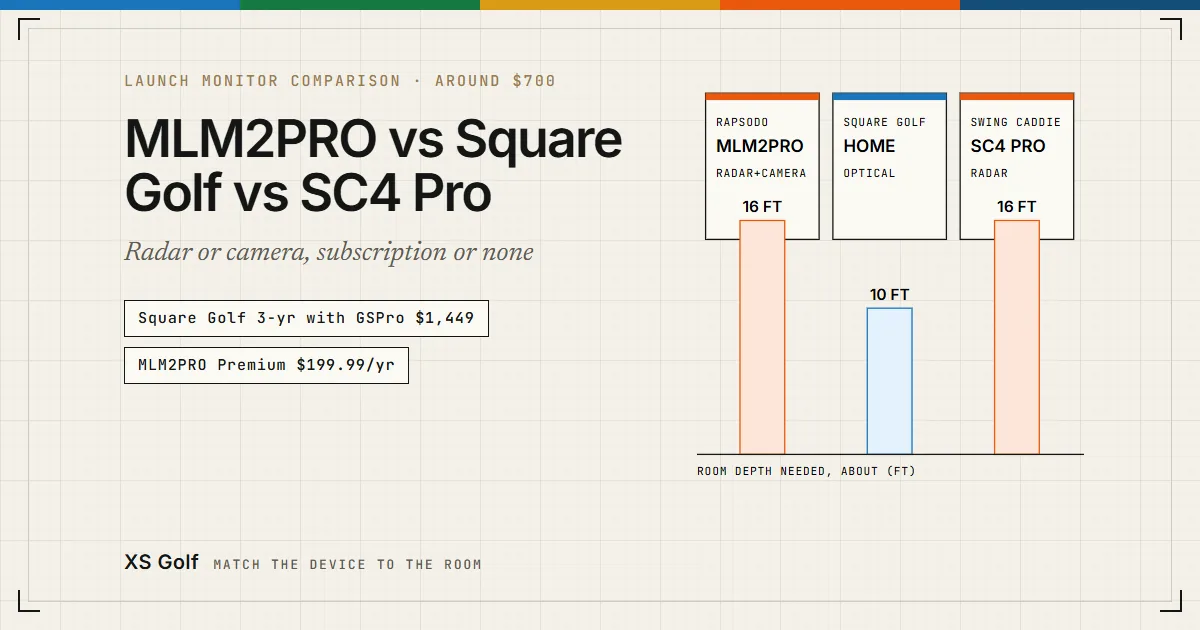
| Room depth | About 16 ft total (radar sits behind the ball) | About 10 ft (PlayBetter) | About 16 ft total (radar sits behind the ball) |
| Subscription fees | Premium $199.99/yr, or $599.99 lifetime | None (optional course credits) | None |
| Simulator software | Rapsodo app; third-party simulation with Premium | Own app; GSPro, E6 Connect and Awesome Golf with no Square Golf fee (GSPro license $250/yr) | VOICECADDIE S app; E6 Connect and OptiShot Orion; no official GSPro integration |
| Total cost (year 1) | $749.98 (Premium) or $1,149.98 (lifetime) | $699.99 + optional credits | $499.99 |
| Total cost (3 years, own app) | $1,149.96 (+ RPT balls indoors) | $699.99 + optional credits | $499.99 |
| Total cost (3 years, with GSPro) | $1,899.96 (+ RPT balls indoors) | $1,449.99 | No official GSPro integration |
| Typical use | Range / outdoor | Indoor simulator | Range / outdoor |
The Devices: Individual Profiles
Rapsodo MLM2PRO — $549.99 on sale ($699.99 list)
The MLM2PRO combines Doppler radar with cameras: the radar tracks ball flight and the cameras record swing video and read spin from Rapsodo’s RPT balls. It is the one unit of the three designed for both range and indoor use, with conditions indoors.
What it measures (Rapsodo): ball speed, club speed, smash factor, launch angle, launch direction, spin rate, spin axis, carry and total distance, descent angle, side carry, apex and shot type, with club path and angle of attack added in 2025 for Premium members. Rapsodo does not list face angle. The cameras also record swing video with a shot trace.
The hidden cost problem. The device costs $699. But the device alone doesn’t give you everything the marketing implies. To unlock Premium features — specifically video capture, advanced data analytics, and full simulation integration — you need a Rapsodo Premium Membership. That’s $199.99 per year, or $599.99 as a lifetime unlock (BreakingEighty). Year-one cost at the $549.99 sale price (Rapsodo, 31 October 2026): $749.98 with the annual membership, $1,149.98 with the lifetime unlock. Know it before you buy.
The indoor spin problem. Radar works by tracking ball flight. In a short indoor bay where the ball travels 8–10 feet before hitting a screen, there isn’t enough flight data to accurately calculate spin rate. Rapsodo’s solution is RPT (Radar Performance Technology) balls — specially marked balls that give the radar additional spin data. These work. They cost roughly $45–$60 per dozen and cannot be substituted with regular Titleist or Callaway balls for accurate indoor spin readings. If you’re building a simulator and expect accurate spin data indoors, budget for RPT balls as an ongoing cost.
Outdoor summary: the only radar-and-camera unit of the three, and the one with swing video, for golfers who practise mainly at the range.
Square Golf Launch Monitor — $699.99
Square Golf uses a purely optical system: high-speed cameras positioned in front of the ball, capturing the moment of impact and early ball flight. No radar. No special balls. No subscription.
What makes it different: It sits beside the ball rather than behind it, so it does not need ball flight behind the golfer to read the shot. PlayBetter suggests a room about 10 ft wide, 10 ft deep and 9 ft tall for the unit itself, against roughly 16 ft of total depth for radar units that sit behind the ball; a full simulator with an impact screen still needs the 12 × 15 ft floor in our room standard. In a converted spare bedroom or garage bay where depth is the constraint, that difference can decide the purchase. See our full breakdown of room depth requirements in the simulator build guide.
Data: Square Golf’s cameras read club speed, ball speed, launch angle and spin at impact rather than inferring spin from ball flight, so it does not require special balls. Owner reviews note spin data is more reliable with marked balls.
The subscription-free model: Square Golf has no annual fee. Its own app sells pay-as-you-go course credits (pricing not confirmed). Square Golf charges nothing to connect to GSPro, E6 Connect or Awesome Golf (BreakingEighty), unlike the MLM2PRO, which needs Rapsodo’s Premium membership for third-party simulation. The third-party software is still a separate cost: a GSPro license is $250 a year. If you’re planning to run simulation software on a dedicated PC, budget for that license. For a $0 software option, Muni Golf Sim lists built-in connections for Square Golf (Home and OMNI) and the Rapsodo MLM2PRO; check Rapsodo’s membership terms before relying on it for the MLM2PRO.
The outdoor limitation: This is an indoor-only device and is not designed for a driving range. If outdoor use matters to you, look at the other two.
Indoor summary: the only camera-based unit of the three and the one that fits the shallowest room. Over three years it costs more than the SC4 Pro and less than a subscribed MLM2PRO.
Swing Caddie SC4 Pro — $499.99 on sale
The SC4 Pro is the current model in Voice Caddie’s Swing Caddie portable radar line. Pricing note: Voice Caddie sells the SC4 Pro at $499.99 on sale against a $599.99 list price (re-checked 2 November 2026), and its original SC4 product page redirects to the SC4 Pro. BreakingEighty reports the SC4 Pro uses the same hardware and radar as the SC4, adding spin axis, side spin and dispersion through Voice Caddie’s ProMetrics engine. The SC4 launched at $549 and was cut to $449 in September 2024, according to BreakingEighty; its current retail price is not confirmed. The figures on this page use the SC4 Pro’s $499.99 sale price.
What it measures: ball speed, club speed, smash factor, launch angle, carry and total distance and shot shape (left/right), shown on its own display without a phone. The SC4 Pro adds spin axis, sidespin, backspin and dispersion in the app; PlayBetter notes the new metrics do not appear on the built-in screen.
App and simulator software: the VOICECADDIE S app logs sessions and offers a 3D driving range (Voice Caddie). PlayBetter rates the app experience below the MLM2PRO’s and the Garmin R10’s. For simulator play, Voice Caddie and its dealers list E6 Connect and OptiShot Orion as its simulator platforms, and PlayBetter reports five E6 Connect courses included with the SC4 Pro; Voice Caddie lists no official GSPro integration. PlayBetter also reported at launch that the E6 Connect link with the new app was not yet working; check current status with Voice Caddie.
Accuracy context: as a radar device, the SC4 Pro shares the MLM2PRO’s indoor limitation: it has little ball flight to read in a short bay, so indoor spin is an estimate. PlayBetter describes it as accurate, especially outdoors.
Where it sits: no subscription and a standalone display, at the lowest price of the three.
Direct Head-to-Head
Accuracy and Technology: Radar vs. Camera
The fundamental technical split in this bracket is radar versus optical camera, and it matters more than any spec-sheet comparison.
Radar units, including the MLM2PRO and SC4 Pro, read the ball in flight. Outdoors, with 50+ feet of ball travel before any obstruction, they have plenty to work with. In an indoor bay where the ball hits a screen after 8–12 feet, there is far less flight to read, so indoor spin numbers are estimates unless the unit has another way to read spin (the MLM2PRO’s cameras and RPT balls).
Camera systems like Square Golf photograph the ball at and just after impact, so spin is read from the ball rather than inferred from a long flight. That is why camera units sit beside the ball and need less depth behind it.
At $699, Square Golf is the only camera-based unit in this comparison.
| Scenario | Radar (MLM2PRO / SC4 Pro) | Optical (Square Golf) |
|---|---|---|
| Outdoor range (50+ ft ball flight) | ✓ Designed for this | ✗ Not designed for this |
| Indoor sim bay (8–12 ft ball flight) | ⚠ Spin estimated (MLM2PRO: RPT balls) | ✓ Designed for this |
| Space-constrained room (6–8 ft depth) | ✗ Too little ball flight | ✓ About 10 ft of depth (PlayBetter) |
| Mixed use (range + occasional sim) | ✓ Designed for this | ✗ Not outdoor-capable |
Total Cost of Ownership
Here is what each device costs over three years at list prices, first with its own app and then with GSPro.
Rapsodo MLM2PRO: $549.99 device on sale ($699.99 list) + $199.99/yr Premium membership = $1,149.96 over three years, or $1,149.98 with the $599.99 lifetime unlock. For regular indoor use, add RPT balls: at $45–$60 a dozen, this page estimates about $100 a year, which brings either route to about $1,450.
Square Golf: $699.99 device, no subscription. Its own app sells pay-as-you-go course credits (pricing not confirmed). Square Golf charges $0 to connect to GSPro or E6 Connect, unlike the MLM2PRO, whose third-party simulation sits behind the $199.99/yr Premium membership.
Swing Caddie SC4 Pro: $499.99 device on sale, $599.99 list (Voice Caddie). No mandatory subscription. Simulator play runs through E6 Connect and OptiShot Orion; Voice Caddie lists no official GSPro integration. Three-year total for the device and mandatory software: $499.99, the lowest of the three, with spin inferred from ball flight indoors.
With GSPro: GSPro is a separate license at $250 a year (GSPro), $750 over three years, whichever device it runs with. Square Golf + GSPro: $699.99 + $750 = $1,449.99. MLM2PRO + Premium + GSPro: $1,149.96 + $750 = $1,899.96, before RPT balls. The SC4 Pro has no official GSPro integration.
Matching a Device to Your Setup
Square Golf: if you’re building an indoor simulator
If your primary use is a dedicated simulator bay — a garage, basement or spare room — Square Golf is the device in this comparison built for it. It is the only camera-based unit of the three, it does not require special balls and it has no subscription. It connects to GSPro and E6 Connect with no Square Golf fee; the GSPro license itself is $250 a year.
Check your room against Square Golf’s published space guidance before buying (PlayBetter suggests about 10 × 10 ft with a 9 ft ceiling), and note that it does not work at the range.
Rapsodo MLM2PRO: if you mainly practise at the range
The MLM2PRO pairs radar with cameras, adding swing video and the widest metric list of the three. If you practise primarily outdoors and want video-backed shot analysis alongside your launch data, it is the one of the three built for that, with a subscription to budget for.
Go in eyes open on the costs. Budget for Premium Membership from day one. Don’t be surprised by the RPT ball requirement if you ever use it indoors. And know that the $549.99 sale sticker is the beginning of the transaction, not the end.
Swing Caddie SC4 Pro: if you want a standalone range radar
The SC4 Pro has no subscription and a standalone display, at the lowest price of the three. It doesn’t have the MLM2PRO’s video or Square Golf’s camera-based indoor reading. For occasional simulator use it runs E6 Connect and OptiShot Orion; if GSPro is a requirement, Voice Caddie lists no official integration.
When a Different Device Fits Better
Three scenarios where a device outside this bracket fits better:
You just want basic speed and carry data: the Shot Scope LM1 ($199.99, Shot Scope) reports club speed, ball speed, smash factor, carry and total on its own screen. It is not a simulator device: no spin, no launch angle, no course play. See our budget launch monitor comparison.
You want a step-up outdoor radar for fitting or coaching: the FlightScope Mevo Gen2 is about $1,299 (GOLF magazine). Our Uneekor EYE MINI, SkyTrak ST MAX and Mevo Gen2 comparison covers it.
You want a camera-based unit that also works outdoors: the Square Golf Omni ($1,599.99, PlayBetter) is camera-based and designed for indoor and outdoor use; Square Golf announced preorders on 16 March 2026. It sits above this price bracket.
Summary by Use Case
| Use case | Device | Why |
|---|---|---|
| Indoor simulator | Square Golf | Camera-based; no subscription; no Square Golf fee for GSPro (license $250/yr); about 10 ft of depth |
| Outdoor / hybrid | MLM2PRO | Radar + cameras; swing video; widest metric list; $749.98 in year 1 with Premium |
| Standalone range radar | SC4 Pro | Radar; no subscription; built-in display; E6 Connect and OptiShot Orion; lowest price of the three |
If you’re weighing this bracket against other units under $1,000, our full sub-$1K roundup adds the Garmin Approach R10 and Shot Scope LM1. The simulation software that runs on top of any of these devices is covered in our simulator software guide.
Frequently Asked Questions
Which of these three has the lowest 3-year cost?
The Swing Caddie SC4 Pro, at $499.99 over three years (Voice Caddie sale price, 2 November 2026; $599.99 list), because there is no mandatory subscription. Square Golf is $699.99 plus optional pay-as-you-go course credits on its own app, or $1,449.99 with three years of GSPro at $250 a year. The Rapsodo MLM2PRO, at its $549.99 sale price, is $1,149.96 with three years of the $199.99/year Premium membership, or $1,149.98 with the $599.99 lifetime unlock, before RPT balls for indoor use.
Can the Square Golf be used outdoors?
Not effectively. It is an indoor optical system and is not designed for outdoor use. If you spend meaningful time at the range, the MLM2PRO or the SC4 Pro are the units in this group built for it.
Do I need special balls?
Only for the radar-based units indoors. The Rapsodo MLM2PRO needs RPT balls for reliable indoor spin data, which adds roughly $100/year for regular indoor use. Square Golf measures at impact optically and works with any ball, including whatever you already play.
Which works in a shallow garage?
Square Golf. PlayBetter suggests about 10 ft of depth for the unit itself (a full simulator with an impact screen still needs the 15 ft in our room standard), while radar units such as the MLM2PRO and SC4 Pro sit behind the ball and want roughly 16 ft of total depth. For the full room-planning picture, see our home golf simulator buying guide.
Which one reads indoor spin most directly?
Square Golf. Optical systems capture the impact event directly, so spin does not have to be inferred from a short indoor ball flight. The MLM2PRO can produce good indoor numbers but only with RPT balls and enough depth; the SC4 Pro infers spin from ball flight, so it has the least to work with indoors. If you are also considering units above this price band, our best launch monitors under $1,000 guide covers the rest of the bracket.
Sources & how we put this together
This comparison is based on manufacturer specifications and published pricing from Rapsodo, Square Golf, and Voice Caddie product listings; subscription terms from each maker’s published plans; and owner reports aggregated from r/Golfsimulator and GolfWRX forum threads. Figures were checked in July 2026 (the Swing Caddie SC4 Pro price on 23 October 2026) and change often — confirm current pricing before you buy. It does not describe first-party robot or launch-monitor testing; a lab, tester panel, and re-test policy are commitments we’re building out from 2027 forward, and we won’t imply results we don’t have. Our full process is on the XS Golf Standards page.
Price it: Price a complete build in our Cost Calculator with the Rapsodo MLM2PRO, Square Golf or Swing Caddie SC4 Pro selected (the Rapsodo MLM2PRO and the Swing Caddie SC4 Pro open with the room depth set to 16 ft or more, which the calculator requires for radar units).