Play these 6 courses on a simulator before you book the trip
Last updated: September 19, 2026
A simulator will not save you strokes at Pebble Beach. That claim gets made a lot and it does not hold up: you cannot practise a firm coastal lie, a caddie’s read, or the specific stomach-drop of standing on a first tee you have been thinking about for a decade.
New for 2026: the booking side of this has changed as much as the practice side. Indoor simulator bays now list on the same marketplace as tee times, and the platform you use to reserve the round abroad depends heavily on where you are going. Our guide to golf booking in 2026 covers what works region by region, including Hawaii, Mexico, Iceland and Greenland.
What a simulator does give you is a map. You arrive already knowing which holes ask a question and which ones just want you to hit a fairway. On a trip where a single round can cost more than a set of irons, knowing where not to miss is worth real money.
That is the honest case for loading a destination course before you travel, and it is a good one.
What indoor reps actually transfer
Useful before a trip:
- Hole shape and sequencing. You stop being surprised by dogleg direction, blind tee shots, and where the trouble sits.
- Yardage decisions off the tee. If a hole gives you a 250-yard layup or a 285-yard carry, you can decide that at home instead of on the clock.
- Green orientation and pin quadrants. Approach angle matters more than approach distance on most great courses.
- Club gapping under a specific set of demands. A course that keeps asking for 190 yards will tell you fast whether your 4-iron and hybrid are the same club.
Not useful, and worth being blunt about:
- Firmness and bounce. Most software models roll-out generically. Links turf in August does things your sim will not show you.
- Wind you can feel. You can dial 20 mph into the settings, but you cannot practise trusting a knockdown while your hat is trying to leave.
- Lies. Rough depth, sandy waste areas, and pot bunkers are approximations indoors.
- Walking. Bethpage Black and every course at Bandon Dunes are walking-only. Nothing indoors prepares your legs for that.
Treat the sim as reconnaissance, not rehearsal.
A note on what is actually in your library
Course availability depends on your software, not on which course is famous, and the distinction between licensed and community-built matters.
TrackMan includes a course library with its software subscription, and St Andrews and Pinehurst No. 2 sit inside it. Both were among the first 15 courses rebuilt on the newer Virtual Golf 3 engine, alongside Muirfield Village, Royal County Down, Wentworth and Valderrama. Pebble Beach is different: TrackMan sells it as a separate Pebble Beach Course Pack covering Pebble Beach Golf Links, Spyglass Hill, The Links at Spanish Bay and The Hay, bought as an add-on to the standard library rather than included in it.
GSPro takes the opposite approach. Its community-built library runs to roughly 2,000 courses and covers essentially every name on this list, included with an active licence, with premium packs existing mainly for officially licensed versions. Those community builds are unofficial recreations. The good ones are very good. Quality across the library is uneven, and there is no central standard, so check the file’s reviews before you decide you have “played” a course.
E6 Connect sits in between, with a tiered subscription and licensed venues including Pebble Beach, TPC Sawgrass and Bethpage Black.
These subscriptions and course packs are a running cost rather than a one-off, which is worth folding into your numbers if you are still working out what a home simulator really costs over three years. If you have not bought hardware yet, start with the home simulator setups guide instead.
XS Golf has not played these files side by side, so treat the above as a licensing map rather than a quality ranking.
1. The Old Course, St Andrews
Getting on is the whole problem. The daily ballot is a genuine lottery, heavily oversubscribed, and the course is closed on Sundays. The other route is the Links Trust’s advance application, submitted the September before the year you want to play. Green fees are published seasonally by the Trust, and 2026 third-party guides put the Old Course round in the mid-£300s. That figure is not confirmed against the Trust’s own rate card, so budget from standrews.com rather than from this page.
One planning detail matters more than the price: The Open returns to the Old Course in 2027, and the course closes from around mid-June to mid-July that year, which tightens availability across the whole season.
Indoors, the Old Course rewards a specific kind of study. The fairways are wide and the double greens are enormous, which means your scoring problems will be lag putting and approach angle rather than driving accuracy. Play it a few times and pay attention to where you leave yourself 90 feet. That is the number you can genuinely reduce with preparation.
2. Pebble Beach Golf Links
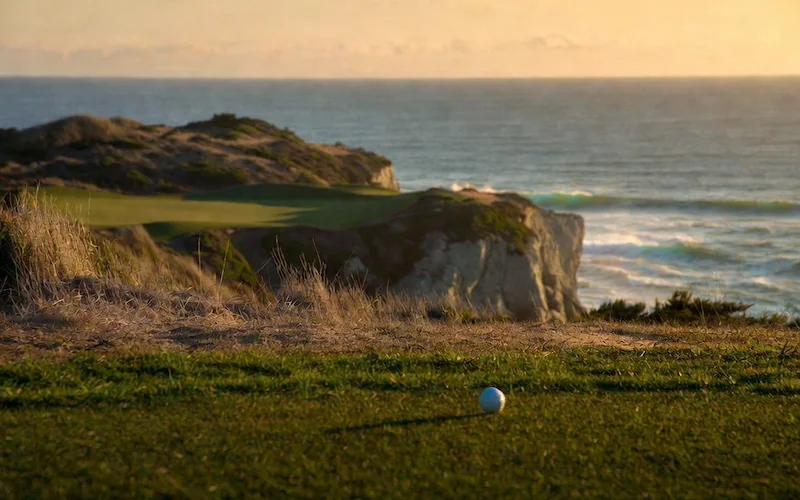
The numbers are public and they are not small. The green fee is $695 per player from April 2026, with a $60 cart fee, or caddie rates of $155 for a single bag and $210 for a double. Resort guests can book up to 18 months out; non-guests are effectively limited to 24-hour availability, and a two-night minimum stay usually applies. In practice that means the trip is a resort stay with a round attached, not a round with a hotel attached.
The greens are tiny, several of them are perched, and your miss patterns are punished by geography rather than by rough. Indoors, work on carry distance rather than total distance, because on the short par 4s and the 7th you are landing the ball on a surface with nowhere to run out. If your launch monitor gives you a carry standard deviation, this is the course where that number becomes the interesting one.
3. Pinehurst No. 2
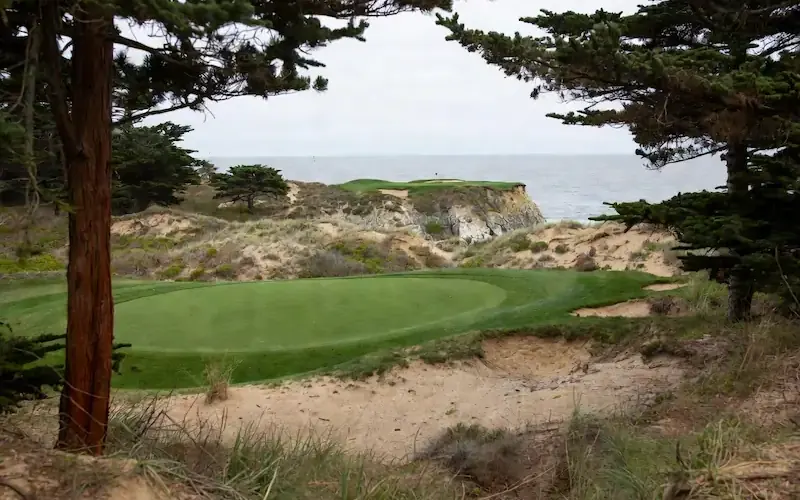
Pricing here resists a single figure. No. 2 requires a two-night resort stay, and the green fee is bundled into a package rather than sold on its own; a Pinehurst reservationist told GOLF.com that packages without a No. 2 tee time carry a $250 surcharge to add one, and a second round on No. 2 runs $595 in peak season and $360 off-season. That reporting dates from 2024. Confirm current package pricing with the resort before you plan around it.
The design lesson transfers better than almost any course on this list. Ross’s crowned greens repel anything that lands slightly off-line, so a shot that would be a 20-foot putt elsewhere ends up 15 yards away in a collection area. Indoors, that shows up as a scoring pattern you can read: count how many greens you miss and where the ball ends up. Then practise the shot you keep leaving yourself, which for most people is a putt or a bump from off the surface.
4. TPC Sawgrass, Players Stadium Course
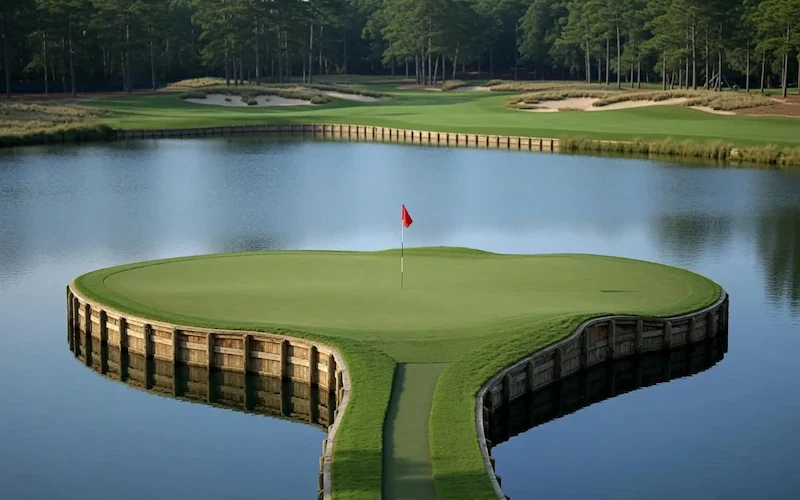
The most accessible of the group, and priced accordingly. The 2026 rack rate is $550 from June through August and $750 the rest of the year, excluding the period around The Players, and the peak figure is a $50 increase over 2025. That fee covers cart, a forecaddie for the group and range balls, and the course uses dynamic pricing that moves with demand. Tee times open 14 days ahead without lodging, or further out through a package with the Sawgrass Marriott.
Everyone loads this course for the 17th. Fine. Hit it 40 times indoors and you will learn something more useful than confidence: you will learn which club produces your tightest dispersion from 130 yards, and whether you actually want that club when it matters. The rest of the layout is a Pete Dye water-management exam, and the 18th tee shot is arguably harder than the island green.
5. Bethpage Black
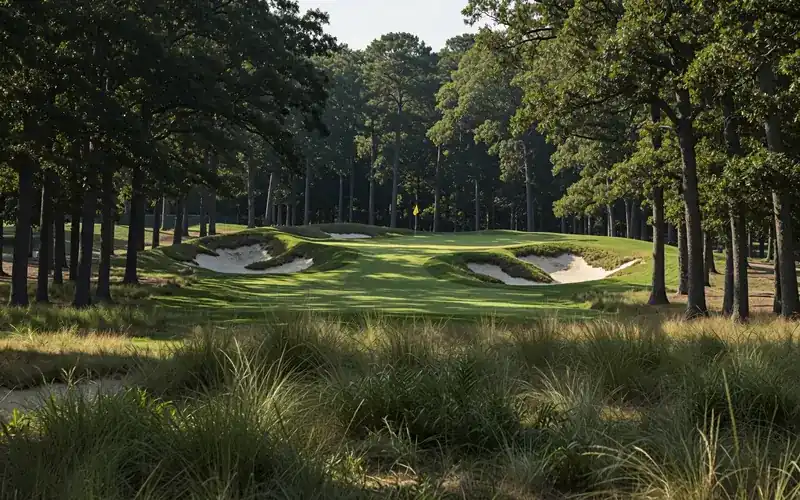
The best value on this list by a distance. The 2026 state-park fee sheet lists $70 on weekdays and $80 at weekends for New York residents, and $140 and $160 for non-residents, plus a $5 per-player reservation fee. Residents can book seven days out, non-residents five. Carts are not permitted on the Black; you walk it or you push a trolley. It hosted the Ryder Cup in September 2025 and reopened to public play that October.
The course plays 7,468 yards to a par of 71, with a course rating of 77.5 and a slope of 155. Those numbers are the point of simulating it. Bethpage asks for forced carries off several tees, and the honest question a sim answers is whether you have the driving distance to play it from a tee that will not ruin your day. If you are hitting 3-wood into par 4s indoors, the Red course is the better round and there is nothing wrong with admitting that before you have driven to Farmingdale.
6. Bandon Dunes

2026 green fees run from $130 for a resort guest in January to $375 in the June-to-September peak, with day guests paying roughly $50 more and a same-day replay costing half the standard fee. Oregon residents get the resort-guest rate, and every course is walking only. The constraint is lodging, not golf: all four reservation windows for the 2027 season had closed by 20 April 2026, with the 2028 lottery expected around September. The resort also aerifies 5–7 May and 22–24 September in 2026, with a 25% discount on any course played within five days of aerification.
Indoors, the Bandon builds are among the most-played files in the GSPro community, and they teach the shot most American golfers never practise: the low runner. Wide fairways, firm ground, and greens you can approach along the ground rather than through the air. If your sim lets you adjust firmness, this is the course to turn it up on.
If Oregon is too far
Whistling Straits does something similar within reach of Milwaukee. Kohler’s 2026 policies list the Straits as walking-only with a $90 per-person caddie fee and a recommended $70 per bag gratuity, plus twilight rates at 30% off rack and super-twilight at 45%. Third-party 2026 write-ups put the Straits green fee around $600 in peak season; Kohler publishes the current rate directly, and that is the number to use.
Using the indoor round properly
Play the course three to five times, not once. The first round is sightseeing and tells you nothing.
Keep a note for each hole with the club off the tee, the number into the green, and the safe miss. Take that note with you. A page of your own yardages beats a course guide you bought in the pro shop that morning.
Lock your bag setup weeks out. A new shaft or an unfamiliar ball is a bad idea on a $695 round, and the sim is the right place to make that decision.
Then, when you get home, play it again. Comparing what you did indoors with what actually happened is the most useful part of the whole exercise, and it is usually humbling.
If none of these six fit the trip you are actually planning, the US golf travel destinations guide covers a wider range of budgets.
Green fees, booking windows and course availability change. Everything above was checked against published sources in August 2026; confirm current rates and tee-time policies directly with each course before booking. Images on this page are illustrative and are not photographs of the courses named.