TruGolf Apogee vs Golf Daddy (Benchmark Golf): What $7,995 Buys That $100 Can’t
Last updated: September 14, 2026
Two products that should never appear in the same sentence
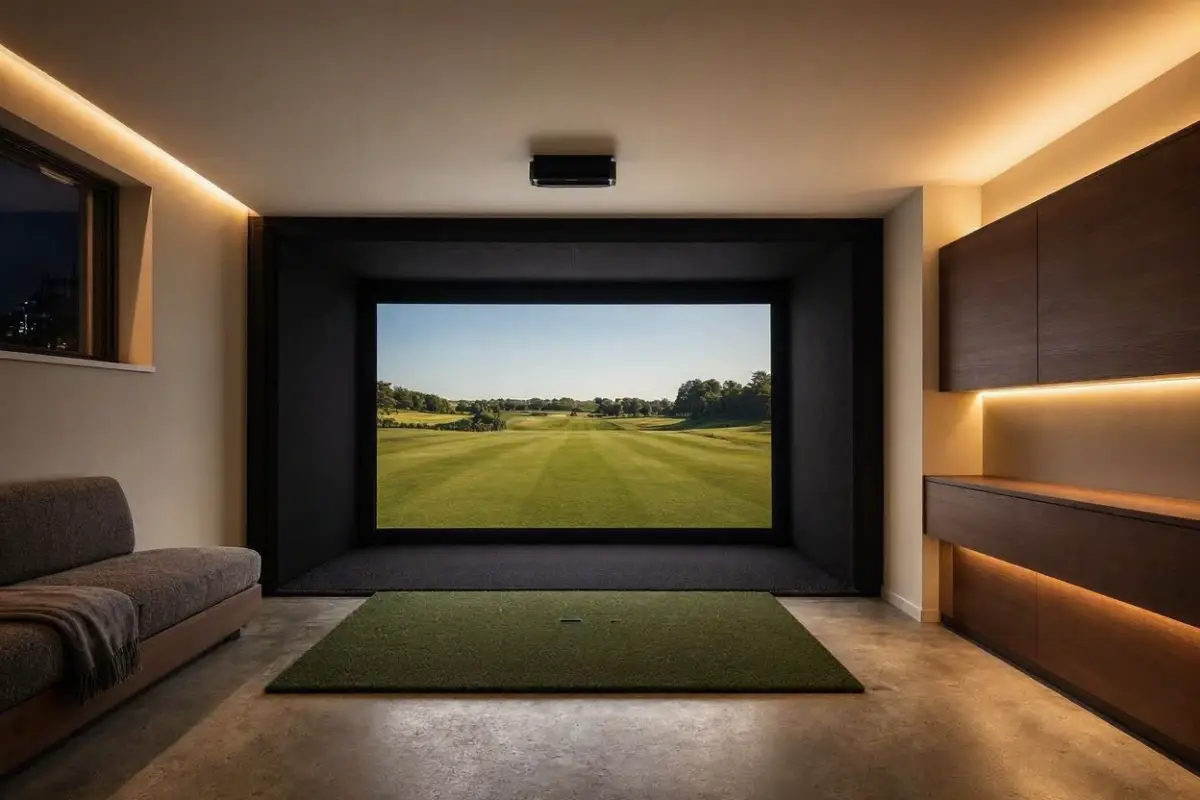
The TruGolf APOGEE is a ceiling-mounted camera system that costs $7,995 and never moves once it is installed. Golf Daddy is a rubber mat and a phone tripod that costs about a hundred dollars and packs away in seconds. Search interest keeps pushing them together anyway, because both get sold under the word “simulator” and because one of them has spent two years dominating golf advertising on Instagram and TikTok.
There is fresh reason to look again. On 26 August 2026 the company announced that Golf Daddy had folded into Benchmark Motion and rebranded as Benchmark Golf, with the mat-and-phone product now sold as Golf at Home. New name, same physics. That matters more than the branding, because the physics is the entire story here.
The short version: one of these devices measures a golf ball and the other one never sees a golf ball at all. Everything else follows from that.
Quick Verdict
These are not competitors, and the price gap is the least interesting difference between them
One is a launch monitor. The other is a swing trainer with a game attached. Pick by what you need the numbers to do.
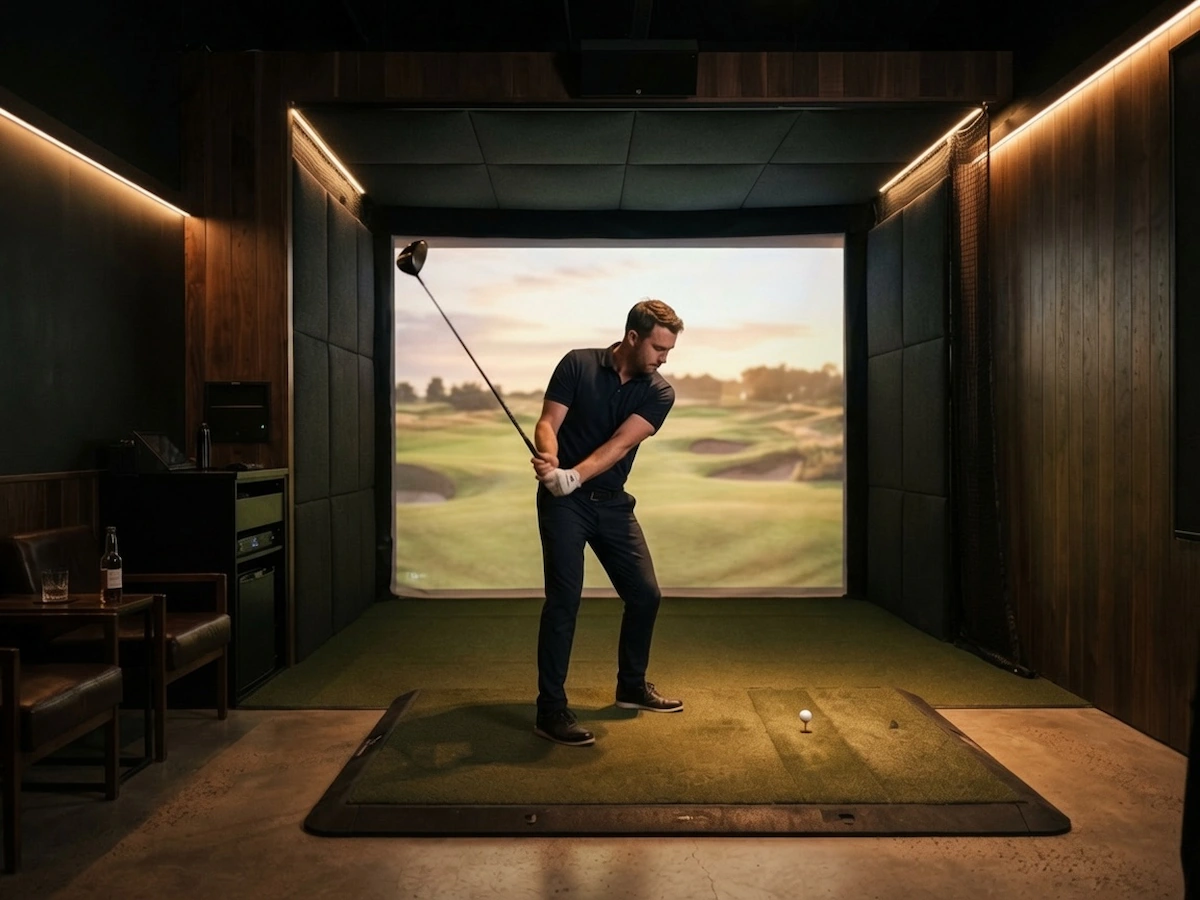
- TruGolf APOGEE ($7,995 at retail): ceiling-mounted stereoscopic cameras that measure ball speed, spin, launch and club delivery at impact, with slow-motion point-of-impact video and a year of E6 included. Needs a 9–10 ft ceiling, a dedicated room and a Windows gaming PC. Buy it if you are building a permanent bay you will not reconfigure.
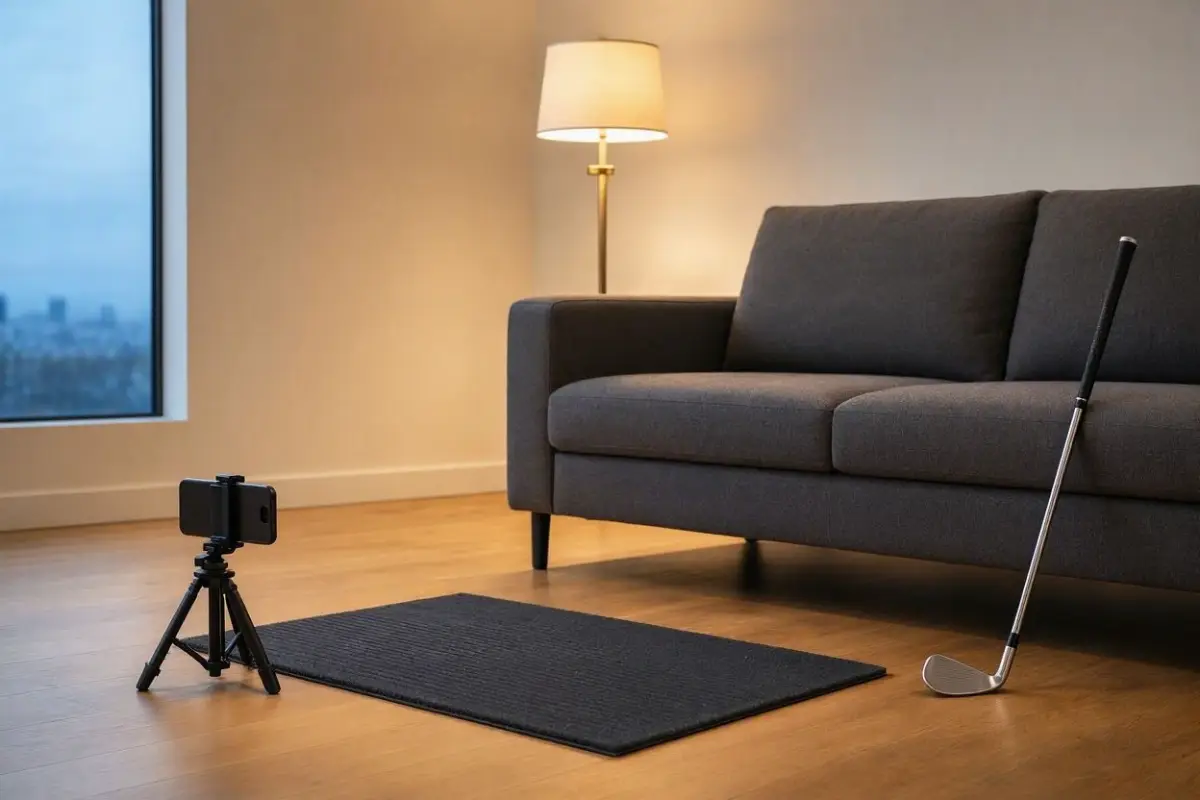
- Golf at Home by Benchmark Golf, formerly Golf Daddy (around $100): a divot mat plus your phone on a tripod. It reads your body and the mark you leave in the mat, then simulates a ball flight it never observed. Fun in a living room. Not a source of yardages.
- If you actually want measured ball data on a normal budget: neither of these is your answer. The $700–$3,500 optical and hybrid bracket is, and we cover it in the launch monitors under $1,000 guide and the best home golf simulators roundup.
The honest framing is not “which is better value.” It is that a $100 mat and an $8,000 camera array are answering two different questions, and only one of them is the question most buyers are actually asking.
How we evaluated these two products
XS Golf did not physically test either product. This comparison is built from manufacturer specifications published by TruGolf and Benchmark Golf, independent third-party reviews that did put hands on the hardware, and aggregated owner feedback from retail listings and app stores. Every performance claim below is attributed to the party that made it. Where a specification could not be confirmed against a primary source, it is marked N/C rather than estimated. Our full method is described on the XS Golf standards page.
One gap is worth naming up front. We found substantial independent testing of Golf Daddy and very little independent accuracy testing of the APOGEE. That asymmetry shapes what can honestly be said about each, and we have not papered over it.
At a glance
| Spec | TruGolf APOGEE | Golf at Home (Benchmark Golf / Golf Daddy) |
|---|---|---|
| Price | $7,995 at retail for the launch monitor | Around $100, frequently discounted |
| What it watches | The ball and the club head, at impact | Your body in 3D and the mark left in the mat |
| Technology | Overhead stereoscopic high-speed cameras, Instant Impact processing | Phone camera plus a divot-reading practice mat |
| Ball required | Yes, any standard unmarked ball | No. Real or foam balls optional |
| Ball data | Ball speed, back spin, side spin, vertical launch angle, horizontal launch direction | None measured. Ball flight is simulated from swing and impact inputs |
| Club data | Club head speed, club face angle, club path. Dynamic loft and dynamic lie require club head stickers | Contact quality and face presentation inferred from the mat |
| Size and weight | 38″ W × 5½” H × 8″ D, approximately 22 lbs | Mat, magnetic tripod, carry stand |
| Mounting | Ceiling, 9–10 ft above the hitting surface, 21–25 in in front of the tee | Floor. Tripod stands in front of you |
| Ceiling height | 9 ft minimum per TruGolf | At least 9 ft for a typical adult full swing, per owner feedback at Dick’s Sporting Goods |
| Software included | E6 by TruGolf ENJOY subscription, one year, 15,000 courses | Benchmark Golf app, free with the mat |
| Third-party software | Disputed — see below. N/C | None |
| PC required | Yes, Windows. RTX 3060 12GB class for the 2026 E6 build | No. iOS or Android phone |
| Recurring cost | E6 renewal after year one. Apogee-specific tier pricing N/C | App free. Optional coaching membership renews at $119/yr |
| Indoor / outdoor | Indoor only | Both, per the manufacturer |
Measuring versus predicting: the difference that decides everything
The APOGEE hangs above your head and fires high-speed cameras at the moment of contact. TruGolf’s published data set is ball speed, back spin, side spin, vertical launch angle, horizontal launch direction, club head speed, club face angle and club path. Those are observations of physical events. Ball flight is then calculated from them, which is how every photometric unit works, including the ones costing five times as much.
Benchmark Golf is explicit on its own product page that Golf at Home is not a radar launch monitor and does not track the ball. The phone camera reads your full-body swing in three dimensions, the mat registers where and how the club arrived, and the app produces a ball flight from those two inputs. No ball is observed, so no ball speed is measured, no spin rate is measured, and no launch angle is measured. Every number the app shows you is a model output.
That is not automatically worthless. A model fed good inputs can be useful for face and path feedback, and the mat genuinely does show you contact — an open face leaves an open mark. The problem arrives when the output is presented in yards, because a yardage carries an authority the underlying measurement cannot support. If you want the fuller version of this distinction, our golf simulator software guide covers how different platforms treat measured versus derived metrics.
What independent reviewers found with Golf Daddy
This is the best-documented cheap simulator in golf, and the documentation is not kind.
MyGolfSpy’s Jamie Danbrook reviewed it in 2024 and found the marketing claims fell well short, with durability concerns around both the tripod and the mat. He revisited it a year later under a headline calling it the worst product the outlet had tried. The follow-up credited an Android release and a run of app patches, but concluded the faults still outweighed any benefit and that better alternatives had arrived in the meantime. He also made a coaching point worth more than any accuracy figure: because the system needs you to strike down into the mat to leave a readable mark, it rewards a move you may not want to take to the course.
MyGolfSpy’s later roundup of no-ball simulators put Golf Daddy in the skip column, citing a mat that wears quickly, software that had not meaningfully improved, a club list limited to four options, and shots that either failed to register or returned results far from reality.
Tomorrow’s Golfer tested a 2024 unit and reported some distances off by more than ten yards along with swings the system missed entirely. They were careful to frame that as an account of one unit rather than a lab verdict on every version since, and we will hold the same line.
Owner feedback tracks the reviews. Retail listings at Dick’s Sporting Goods and Golf Galaxy carry repeated reports of app crashes and freezes, swings the app rejects, calibration that eats an hour, identical swings returning wildly different numbers, and in one aggregated summary a 6-iron logged at 33 yards. A 2026 review at Golfer Hive, written after 30 days with the unit, added a physical problem the spec sheet will not tell you about: on bare concrete the mat slid two to four inches per swing, which means realignment between shots.
Against that, the manufacturer’s current App Store listing claims patented AI swing tracking with accuracy comparable to simulators costing thousands of dollars. We found no independent testing that supports that claim, and a good deal that contradicts it. Treat it as marketing.
The 2026 rebrand does bring real changes — a magnetic tripod, a rebuilt physics system in recent app updates, and a paid coaching tier that renews at $119 a year. What it does not change is that a phone and a mat cannot see a golf ball.
What can honestly be said about APOGEE accuracy
Less than you would expect for a $7,995 device, and we would rather say so than fill the gap.
We could not find published robot testing or a controlled head-to-head of the APOGEE against a GCQuad or a TrackMan from any of the outlets whose methodology we trust. What exists is retailer documentation, specification sheets and reviewer impressions. Those impressions are broadly positive on the things that are easy to observe — instant on-screen response thanks to onboard processing, consistent left- and right-handed play from a single mounted position, and a point-of-impact video replay that reviewers repeatedly single out as the standout feature.
One data point cuts the other way and deserves airing. Par2Pro, a retailer that sells the unit, states on its own APOGEE product page that it is still working with TruGolf on improving the accuracy of its demo unit. A seller volunteering that about a product it stocks is unusual, and it is a more useful signal than a dozen enthusiastic blog reviews.
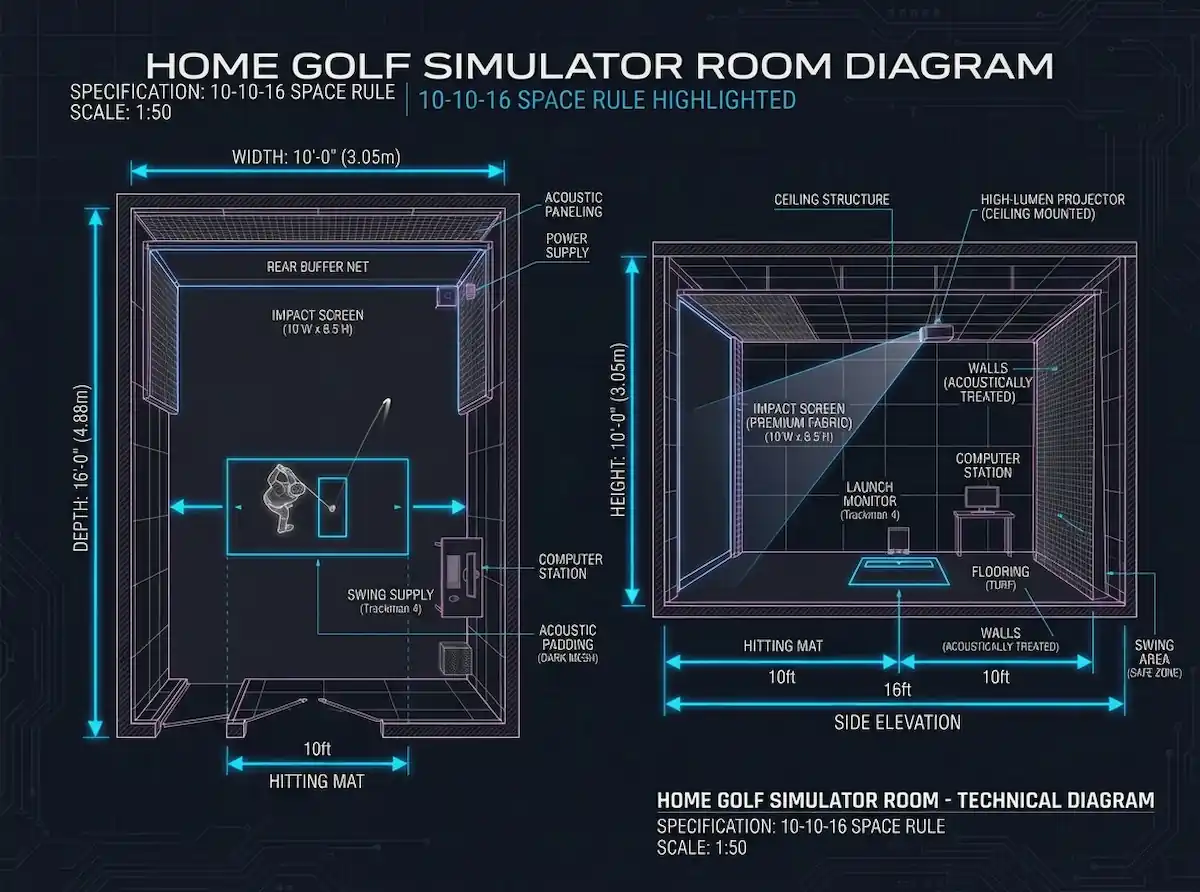
Two practical constraints also get understated. The hitting zone is reported at roughly 8 inches wide by 10 inches long, which is small next to competing overhead units and means ball placement matters more than the marketing suggests. And mounting tolerance is tight: 9 to 10 feet above the hitting surface, 21 to 25 inches in front of the tee. Get either wrong and you are troubleshooting the room, not the device. Our installation guide and setup guide cover the measuring work that has to happen before anything gets screwed into a joist.
The GSPro question, unresolved
If you care about GSPro, do not take anybody’s word for it, including ours.
Sources contradict each other directly. One major simulator retailer states the APOGEE is officially compatible with GSPro. A detailed 2026 review at ParPercision states the opposite, that it does not natively support GSPro, and recommends the ProTee VX to anyone who needs it. Rain or Shine Golf lists compatible platforms as TruGolf’s in-house practice software and E6, with no GSPro mention. Another comparison describes the unit as primarily E6-compatible with limited integration elsewhere.
We mark this N/C. If GSPro access decides your purchase, get it in writing from the specific retailer before the order goes in, because the answer may be configuration- or firmware-dependent rather than a simple yes or no. What is not disputed is that E6 is the native home, and one year of the ENJOY tier with 15,000 courses ships with the unit.
The $7,995 is not the number you will spend
The APOGEE is a sensor. A sensor is not a simulator.
To hit a ball into something you need an enclosure or impact screen, a hitting mat, a projector and a Windows PC that meets E6’s requirements. TruGolf’s published minimum for the 2026 E6 build is an i7 10th-generation processor or newer, 24GB of memory and an RTX 3060 with 12GB of video memory. That is a real gaming machine, not a repurposed office desktop, and it is a four-figure line item on its own.
Pricing also varies more by channel than most buyers realise. $7,995 is the widely listed retail price for the launch monitor, and at least one retailer describes that as reduced from $9,000, while TruGolf’s own bundled configurations have been listed starting considerably higher. Compare configurations rather than headline numbers, because what is included in the box differs between sellers.
Software renewal after the included first year is the line item people forget. We could not confirm current Apogee-specific E6 tier pricing, so we are marking it N/C; for scale, Tom’s Guide has put the E6 ENJOY tier at $450 a year in its coverage of TruGolf’s LaunchBox. Add it all up before committing. Our three-year cost of ownership breakdown exists because the sensor price is routinely half the real total, and the build guide works through the rest of the room.
Space, and who each room suits
The overhead mount is the APOGEE’s genuine structural advantage and it is easy to undersell. Nothing sits on the floor and nothing sits on the target line, so a left-hander and a right-hander share a bay without moving hardware, and nobody kicks the sensor out of calibration on the way past. In a household with mixed-handed players, or a commercial bay, that alone can justify the category.
The cost is permanence. You need the ceiling height, you need to mount into structure, and once it is up the room is a golf room. If your ceiling is under 9 feet the decision is made for you and a floor-based or hybrid unit is the route — our garage simulator guide under $5,000 is the practical starting point there.
Golf at Home needs far less, though not nothing. Owner feedback at Dick’s Sporting Goods flags that a typical adult still wants around 9 feet of ceiling to make a full swing safely, because you are swinging a real club at full speed with no ball to stop it. That surprises buyers who assumed no ball meant no space requirement. You also need room for the tripod to stand in front of you and a surface that will not send the mat sliding.
Who should buy which
Buy the TruGolf APOGEE if you are building a permanent indoor bay with 9 to 10 feet of ceiling, you want measured ball and club data with no marked balls or ball-placement fuss, you value point-of-impact video, and you are content living primarily inside E6. Budget for the room and the PC alongside it.
Buy Golf at Home if you want a cheap, packable way to make swings indoors in winter, a golf-flavoured game for the family, or a gift for someone who will enjoy the novelty. Judge it as a swing toy with a scoreboard and it holds up better than its reviews suggest. Judge it as a launch monitor and it fails immediately. If you landed here looking for presents rather than gear, our 2026 golf gift guide and personalized gift ideas are better hunting grounds.
Buy neither if what you actually want is real numbers without an $8,000 install. That is the largest group of readers arriving at this comparison, and it is well served in between these two extremes. The budget launch monitor shootout covers the $200–$600 bracket, launch monitors under $1,000 handles the step up, the SkyTrak MAX review and TrackMan versus SkyTrak MAX cover the mid-tier photometric options, and portable launch monitors is the right list if the unit has to travel. For radar and hybrid alternatives around $500–$2,000 see the MLM2PRO, Mevo+ and SC4 comparison and the Garmin Approach R10 review.
Where each one lands
The scores below summarise the published evidence set out above — manufacturer specifications, independent third-party reviews and aggregated owner reports. They are editorial summaries, not test results. XS Golf did not measure either product, and the APOGEE figure in particular rests on specification and experience reporting rather than independent accuracy testing, which we could not find.
- TruGolf APOGEE — 8.4 / 10. A credible permanent-install overhead system with a strong convenience story and an unusually thin independent accuracy record for the money.
- Golf at Home by Benchmark Golf — 4.2 / 10. Enjoyable as a no-ball swing game and priced accordingly. Repeatedly documented as unreliable for anything resembling practice decisions.
Frequently asked questions
Is Golf Daddy accurate?
Not in the sense buyers usually mean. It does not measure the ball at all, so distances and shot shapes are simulated from your body movement and the mark left in the mat. Independent reviewers including MyGolfSpy and Tomorrow’s Golfer reported missed swings and distances well off expectation, and owner reviews at major retailers repeat the pattern. The mat feedback on contact quality is the part most worth having.
Did Golf Daddy change its name?
Yes. The company announced on 26 August 2026 that Golf Daddy had folded into Benchmark Motion and rebranded as Benchmark Golf. The product is now sold as Golf at Home. The hardware concept, a divot mat plus a phone on a tripod, is unchanged.
Does the TruGolf APOGEE need marked balls or club stickers?
No marked balls, and no stickers for the standard data set. TruGolf does specify that dynamic loft and dynamic lie require club head stickers, which ship in the box. Everything else, including ball speed, spin, launch and club path, is captured without them.
What ceiling height does the APOGEE need?
TruGolf specifies mounting 9 to 10 feet above the hitting surface, positioned 21 to 25 inches in front of the tee, with a 9 foot minimum ceiling. Because the unit mounts overhead rather than behind the ball, it does not need the room depth that radar units do, but the height requirement is not negotiable.
Does the APOGEE work with GSPro?
Sources disagree, so we mark this not confirmed. One retailer states official GSPro compatibility while a 2026 review and at least one other retailer’s compatibility list say otherwise. E6 by TruGolf is the native platform and one year of the ENJOY tier is included. If GSPro decides your purchase, confirm it with your retailer in writing first.
Is a $100 no-ball system a reasonable way to start before buying a real simulator?
As a way to keep swinging through winter, yes. As a stepping stone that teaches you anything about your yardages, no, and it can build a downward strike into your motion because the mat has to be marked for the app to read a shot. If the goal is a real setup later, the money is better spent on a used entry-level launch monitor or put toward the room itself. Our eight-week simulator practice program covers what productive indoor practice looks like once you have data worth practising against.
Where to buy and what to check first
The APOGEE is sold through authorised simulator specialists and TruGolf directly rather than general retail. Before ordering, confirm three things with the seller: exactly which E6 tier and course package is included, what renewal costs after year one, and the GSPro position for your configuration. Confirm your ceiling measurement before anything else, because that is the requirement people discover too late.
Golf at Home is sold through Benchmark Golf directly and at Dick’s Sporting Goods. The brand site runs frequent discount promotions, so the price you see depends heavily on when you look. Check the current return policy before buying, and note that the coaching membership is a separate recurring cost at $119 a year.
XS Golf does not carry affiliate links to either product in this comparison. Where our guides do carry them, they are disclosed — see our affiliate disclosure.
Next steps: if the APOGEE is the direction, read the best home golf simulators 2026 roundup for how it sits against the rest of the permanent-install field, then the accessories guide for the enclosure, mat and projector decisions. If a room this dedicated feels like overkill, the dual-use simulator and home theater piece is the argument for making the space earn its keep.