LED Wall vs. Projector for a Golf Simulator: Is a 12-Foot Wall Worth It?
Published: November 22, 2026 · Last updated: November 22, 2026
Quick answer
For most home golf simulators, buy a short-throw projector and a golf impact screen. You can aim at the flag, hit into the picture and replace the fabric when it wears. A direct-view LED wall earns a look when daylight or a busy lounge makes projection hard to see. It also gives you a second job: catching every golf ball before it reaches the electronics.
The size of the picture changes the economics. In one US retail example, the panels for an 11½-foot square come to $26,901. A shorter wall of the same width costs $15,372 in panels and shows the same undistorted 16:9 picture. Before choosing either, decide what your simulator can put in those extra rows. US cabinet listing
Which display fits the way you play?
| Setup | Where it earns its keep | What you give up |
|---|---|---|
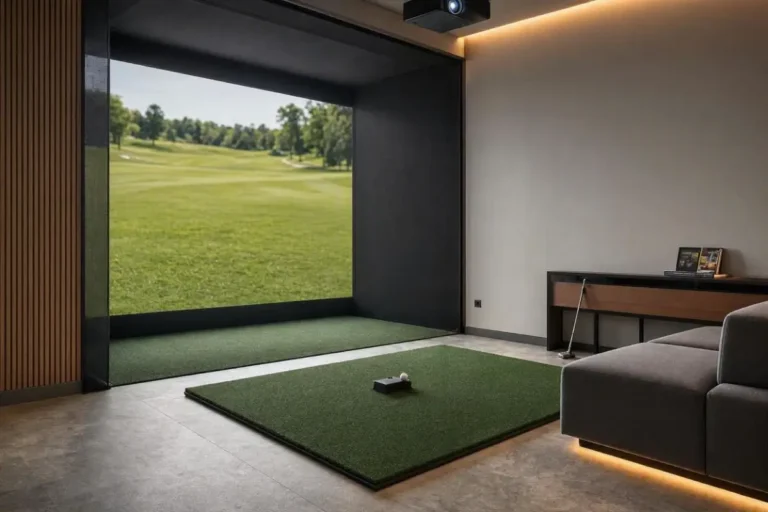
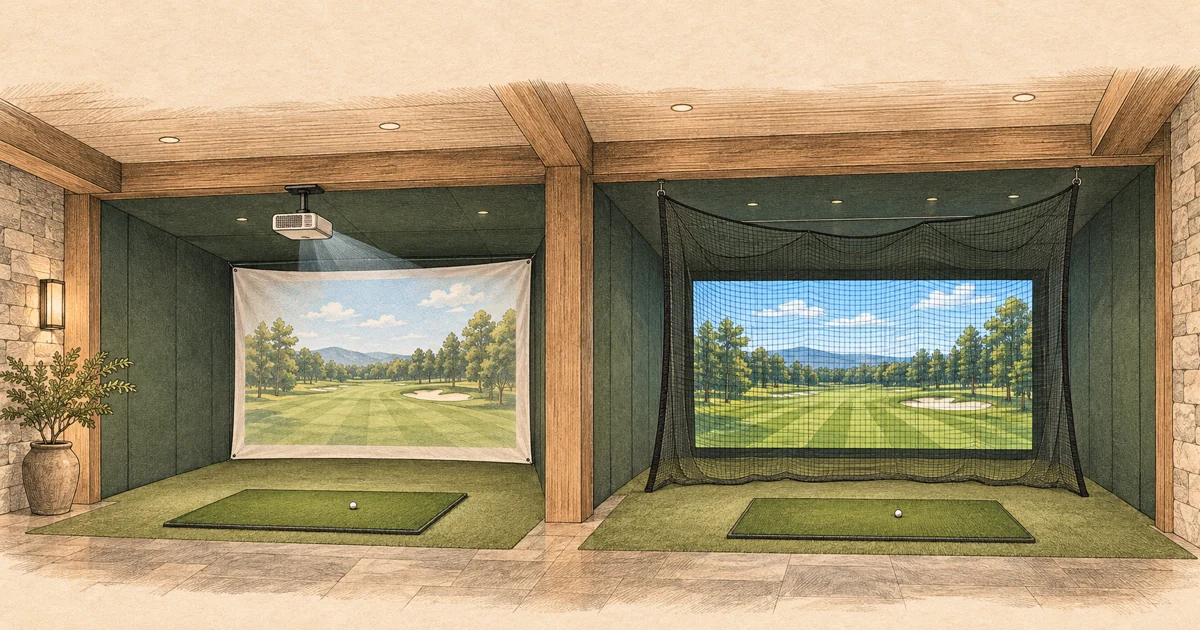
| Short-throw projector + flat impact screen | The home bay where you want to hit into the course. A single fabric surface catches the ball and carries the picture. | Light falling on the fabric lowers contrast. The lens needs a clear path above or beside the player. |
| Direct-view LED + separate golf containment | A bright, multi-use room where you want the course straight ahead and can afford a protected display. The cabinets emit their own light, so walking past the tee cannot cast a projector shadow. | You see the fairway through a barrier. Its deflection takes up depth. Heat, support and repairs become part of the installation. |
| Curved impact screen + projection | A dedicated wide bay where seeing the edges of the hole from the tee is worth the extra setup. | The image must follow the curve. A two-projector system also has an overlap to align, blend and color-match. |
| Practice net + side TV or monitor | The player who mainly wants carry, dispersion and replay, or a household that already owns the TV. | You turn to read the shot. Place the display outside the ball and club paths, including foreseeable mishits. |
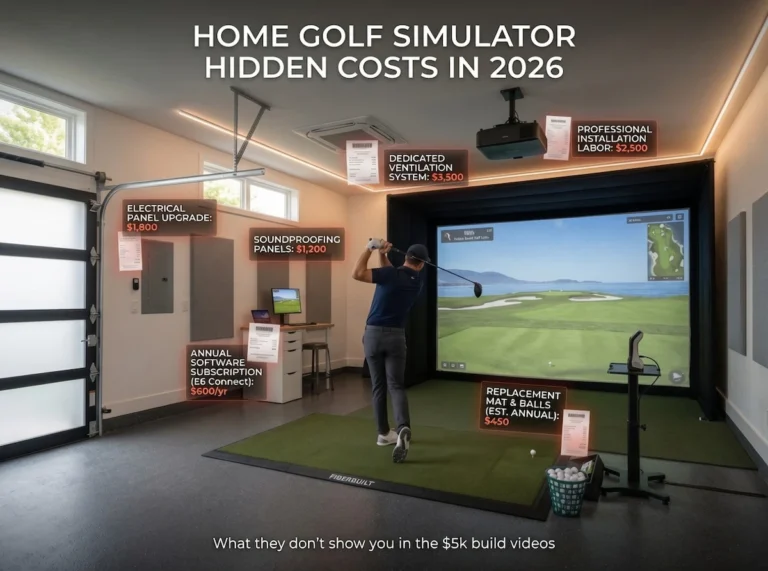
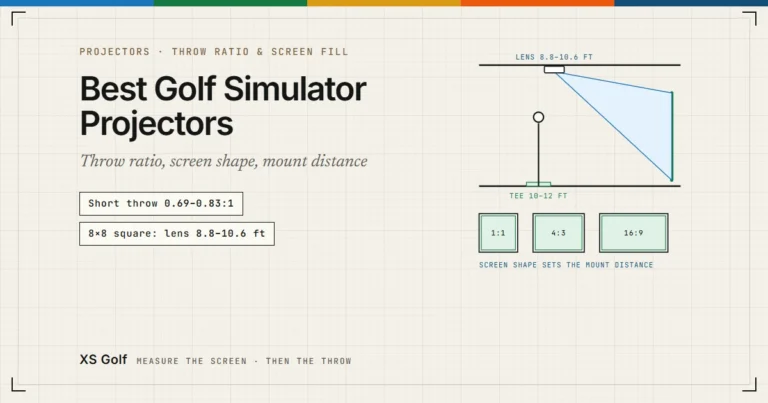
Start with the light you can control. In a garage, close the shade that throws sun onto the target and light the hitting mat separately. Keep the lighting your launch monitor requires. Look at a dark tree line, white yardage text and the slope grid on a green. If those are clear at the hours you play, a projector solves the problem. If customers need the lounge lights on all day, repeat the same comparison with an LED sample behind the proposed net. Projector output is measured in lumens and LED surface brightness in nits. The most useful comparison is the picture at your tee under your lights. XS Golf’s short-throw projector guide
Even arena golf uses projection. Panasonic supplies the image on TGL’s 64-by-53-foot playing screen. For a smaller curved bay, ask how wide a single suitable lens can cover before budgeting for a second projector. BenQ documents a single-projector curved-screen setup with geometric correction. For a dual system, ask to see a putt roll through the blend zone and a pale sky across the seam. Panasonic on TGL · BenQ’s curved-screen guide
A 12-foot square buys a lot of unused screen
A 12-by-12-foot opening measures 3,658 mm on each side, rounded to the nearest millimeter. With 500 mm square cabinets, seven across is 3,500 mm, about 11 ft 6 in. Eight across is 4,000 mm, about 13 ft 1 in. Count the cabinets that fit the clear opening after measuring the floor finish, soffits, mount and service allowances. A 12-foot-wide garage with a 9-foot ceiling cannot take the seven-row square. It may still take a wide image.
| Same 500 mm P2.5 cabinet | Seven columns × seven rows | Seven columns × four rows |
|---|---|---|
| Cabinet count | 49 | 28 |
| Display face | 11.48 × 11.48 ft | 11.48 × 6.56 ft |
| Native pixels | 1,400 × 1,400 | 1,400 × 800 |
| Full-width 16:9 picture | About 1,400 × 788 pixels | About 1,400 × 788 pixels |
| Share of face showing that picture | 56.25% | About 98.4% |
| Cabinet subtotal at $549 each | $26,901 | $15,372 |
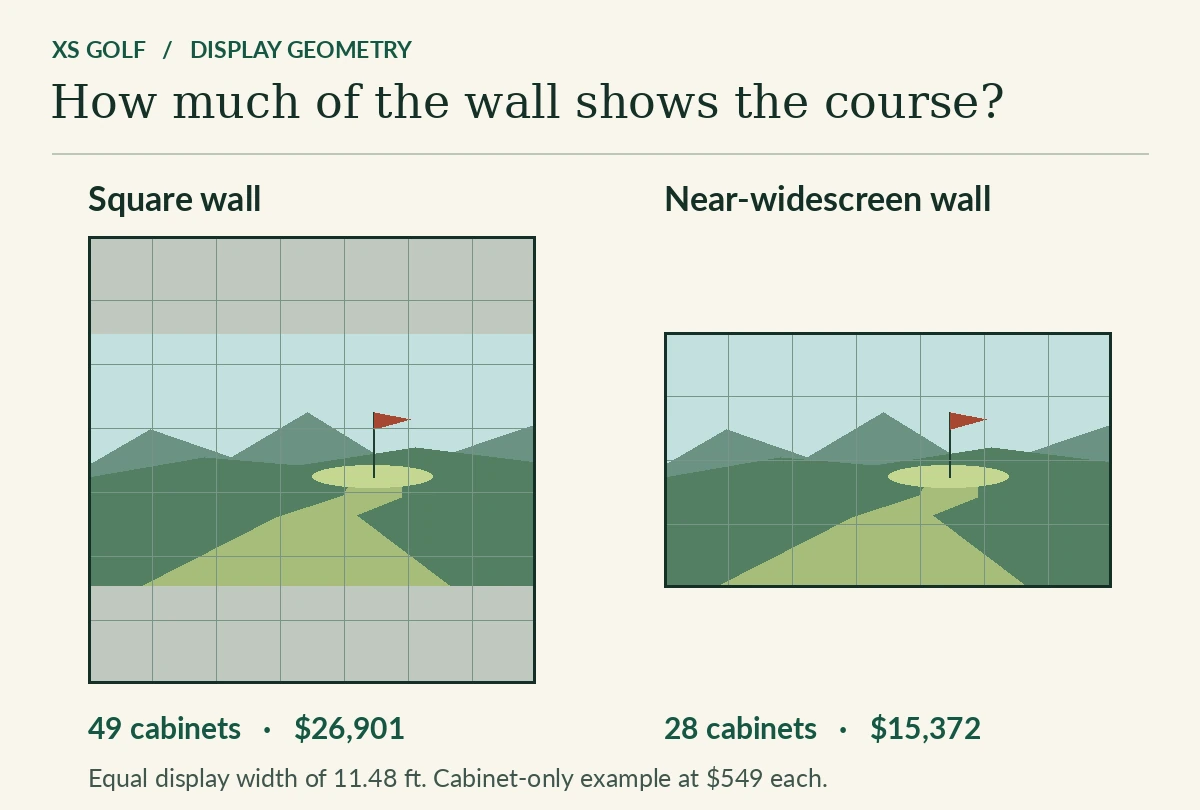
A 16:9 picture at this width is about 6 ft 5½ in. tall on either wall. The square leaves roughly 2 ft 6 in. above and below a centered picture. Dropping three rows saves 21 cabinets and $11,529 at the example price. The hitting enclosure still has to catch high wedges even when the picture is shorter. If you watch football or movies in the room, compare both shapes from the sofa as well as the tee. XS Golf’s dual-use simulator and home theater guide
When is the square worth buying? When your actual software uses its height. Have the installer show a full hole and the shot-data menus at the proposed native resolution. Fit a widescreen image and you get bands. Crop it to fill and you lose the sides. Stretch it and a round ball becomes an oval. A game that renders a genuine square viewport offers a fourth option, but the course view and control placement still depend on the game. Trackman recommends 16:9 or 16:10 for its projector setup. Treat 1:1 as something to demonstrate on your version of GSPro, E6 or Trackman before ordering cabinets. Trackman simulator specifications
What about finer pixels? Pixel pitch is the center-to-center spacing between pixels. LiveTekk lists 200 × 200 pixels in a 500 mm P2.5 cabinet and 256 × 256 in its P1.95 equivalent. Seven across therefore gives 1,400 or 1,792 horizontal pixels. Neither delivers the 1,920 horizontal pixels of Full HD at this width. Read a scorecard and a small carry number through the actual mesh from your tee before paying for finer pitch. If a spectator sits closer, check that seat too. LiveTekk cabinet specifications
Can you hit a real golf ball at an LED wall?
Treat an ordinary LED cabinet as a display. A white golf impact screen can both catch a shot and show a projected image. A protected LED installation needs a separate, golf-rated containment system that lets you see the display. Even the seller of Optoma’s COB display describes it as intended for protected viewing. SMD, GOB and COB describe how the LEDs are mounted or protected. None of those labels establishes a golf-ball impact rating. Optoma FHDC163 seller’s impact guidance · XS Golf’s impact screen and enclosure guide
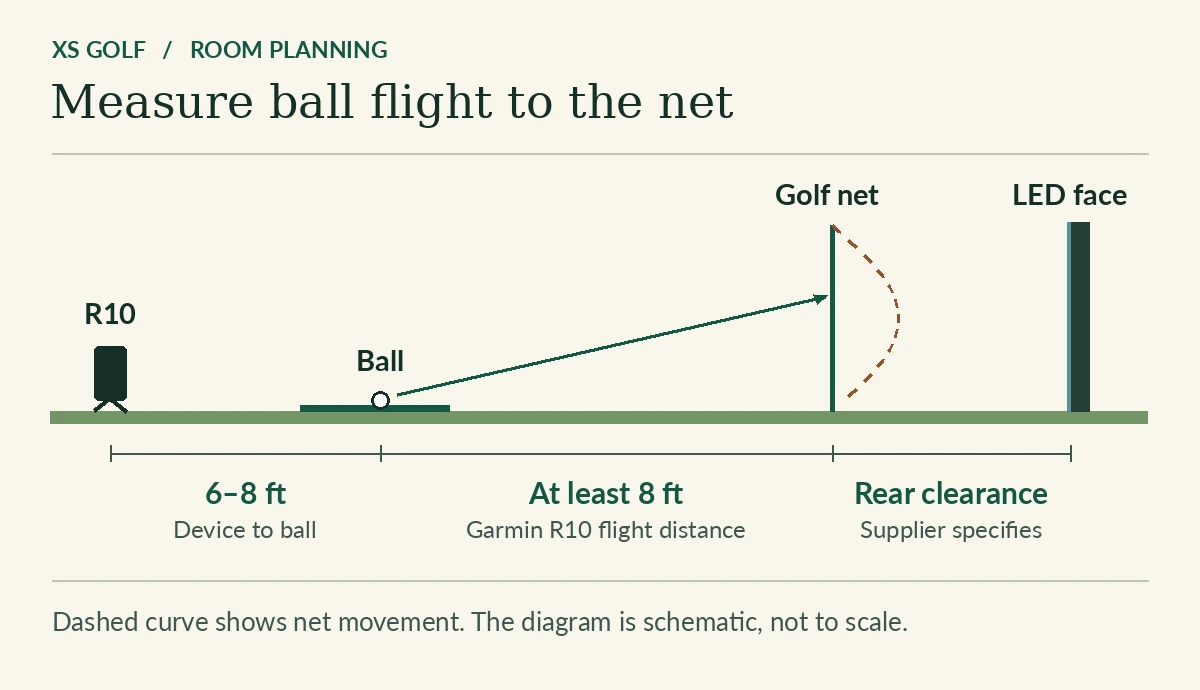
Two measurements are easy to confuse. Ball-to-net distance is the space for the launch monitor to see flight. Net-to-display clearance is the space the barrier needs as it moves back under a strike. For example, Garmin specifies at least 8 ft from ball to net and 6–8 ft from ball back to an Approach R10. That accounts for 14–16 ft from radar to net at the minimum flight distance, before any space behind the net or device. Measuring to the LEDs would overstate the available ball flight. Garmin R10 placement · XS Golf’s room size calculator
The home simulator setup guide walks through the rest of the room, including swing space and ventilation.
Ask the containment supplier for the clearance and ball-speed limits for the complete installation, including how it is hung, side and overhead coverage, frame padding and inspection intervals. Garmin calls for free space behind a net and padding on a frame. A distance from a fabric impact-screen guide cannot establish the clearance for a different net. Some nets use an opaque target sheet to take the repeated hits. If the approved configuration blocks the image or forbids fragile objects behind it, choose a side display or a projector. Keep the required target sheet in place. Garmin’s safety guidance · Spornia’s impact target
What to put on the quote
Compare hardware with hardware first. BenQ’s US guide gives estimated projector prices of $2,299 for the 1080p AH700ST and $2,899 for the 4K AK700ST, both rated at 4,000 ANSI lumens. Add an impact screen, enclosure, mount and installation to either. The $549 US listing used above is a per-cabinet example observed on November 22, 2026. The $26,901 and $15,372 figures are arithmetic at that listing price. Obtain itemized local bids for freight, tax, processor, supports, power, cooling, protection, commissioning and spares. Keep common items such as the launch monitor, mat, PC and software on a separate line in both bids. BenQ’s US pricing guide · US panel listing · Build a conventional baseline in the XS Golf cost calculator
Check the room load against a specific cabinet. As a separate engineering example, Mirackle lists its 500 mm P2.5 PRO at 7.5 kg, 100 W average and 200 W maximum per cabinet. For 49 cabinets that is about 368 kg (810 lb) before the frame, 4.9 kW at the maker’s average and 9.8 kW at maximum. Actual draw depends on brightness and content. Three hours at 4.9 kW is 14.7 kWh, or about $2.94 at an illustrative $0.20/kWh, before cooling and the rest of the simulator. Get the proposed cabinet’s own load data. Have the installer, structural professional and electrician account for the finished assembly, the available power and the heat the room can remove. Mirackle P2.5 PRO specifications
Ask for a live signal test. Give the installer the PC, simulator version, cabinet grid and intended frame rate. NovaStar lists a 3.9-million-pixel output capacity for the VX600 and separate limits for its video inputs. Being under the output ceiling alone does not prove that a particular square input timing works. Request the input resolution, scaling mode and cabinet map in writing. Then watch a shot replay and record the wall with your own swing camera. The LED scan refresh rate, the game’s frame rate and the time between impact and seeing the shot are three different measurements. NovaStar VX600 specifications
Price the first repair. On the projector bid, ask what it costs to replace the impact fabric. On the LED bid, ask who removes and reinstates the net, which components can be serviced from the front, whether matching spare modules are held locally, and whether labor and accidental ball damage are covered. For a commercial bay, ask how many bookings you would lose while waiting for a part.
For a venue, you can put a number on that choice. If the installed LED bid exceeds the projector bid by $18,000 and each additional booked hour contributes $30 after variable costs, you need 600 extra booked hours to recover the premium, before extra power, repairs or financing. Hours you would have sold with either display do not count. Use your own two quotes and margins.
The buying decision
For a home garage, price the flat-screen projector bay first. If room depth or daylight rules it out and you mainly practice, a net and a side display keep your shot data visible without putting electronics downrange. For a commercial lounge, request two LED designs at the same width, square and near-widescreen, then have both demonstrated from the tee with the specified protection. Pay for the extra rows only if your software or a second use gives you a reason to light them.
How we worked this out. XS Golf compared published cabinet, controller, projector and launch-monitor specifications with a US retail listing. The cabinet counts, aspect-ratio calculations and electricity example are our calculations. We have not installed or impact-tested this LED configuration. Specifications, prices and source pages reviewed November 22, 2026.