Best Home Golf Simulators 2026: Complete Setups for Every Budget
Last updated: July 2026 — component pricing checked against manufacturer and retailer listings.
If you are an 8 to 18 handicap golfer, you are in the hardest bracket in golf. You are good enough to hit pure, towering iron shots, but inconsistent enough that a two-way miss can ruin your scorecard. For this intermediate player, hitting into a blank net in the garage without data is actively hurting your game. You don’t need to guess anymore. You need to know your club path, your face angle, and your strike location.
Related: A home simulator is also the smartest way to gather baseline numbers before a club fitting — here’s our Golf Club Fitting Guide for Intermediate Golfers (8–18 Handicap).
Welcome to 2026, the undisputed golden era of the home golf simulator.
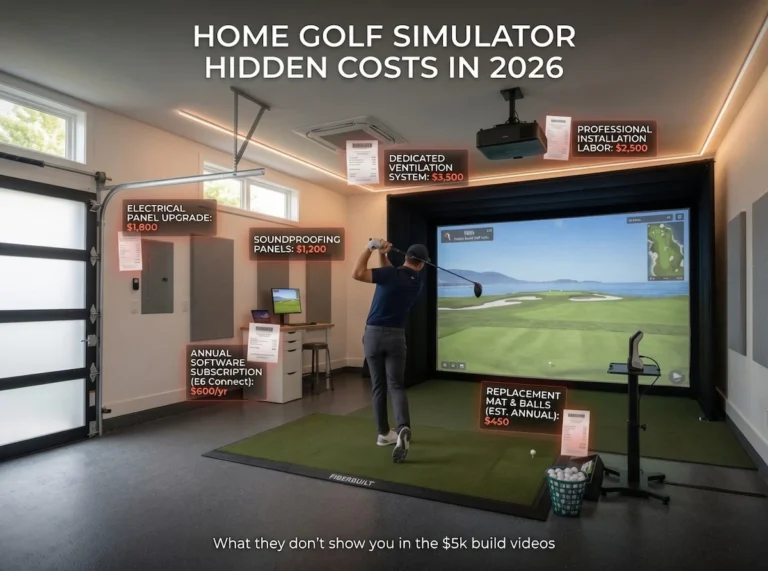
The barrier to entry has officially plummeted, while the technology has skyrocketed. The days of needing a $20,000 commercial build to get accurate spin numbers are over. Today, you can build a hyper-accurate, fully immersive indoor simulator for a fraction of that cost—if you know where to allocate your budget. And once you have chosen your setup, our 3-year TCO guide shows exactly what subscriptions, mat wear, and maintenance will add to your upfront cost.
At XS Golf, we don’t regurgitate manufacturer marketing brochures. We synthesize independent third-party testing — including published side-by-side comparisons against reference units like the TrackMan 4 across various swing speeds and strike locations — to see where each system shines and where it struggles.
Drawing on this synthesized research and independent comparison data, here are the best complete home golf simulator setups for every budget in 2026, including the exact components you need to build them.
Key takeaways
- Best overall: the $5,000 garage build — SkyTrak ST MAX ($2,995) with a DIY mesh screen and EVVA turf lands around $4,900 and is the value sweet spot for 8–18 handicappers.
- Under $1,500: Square Golf ($699) with a pop-up net and stance mat (~$1,200 total) — legitimate data for small spaces and strict budgets, viewed on an iPad or TV.
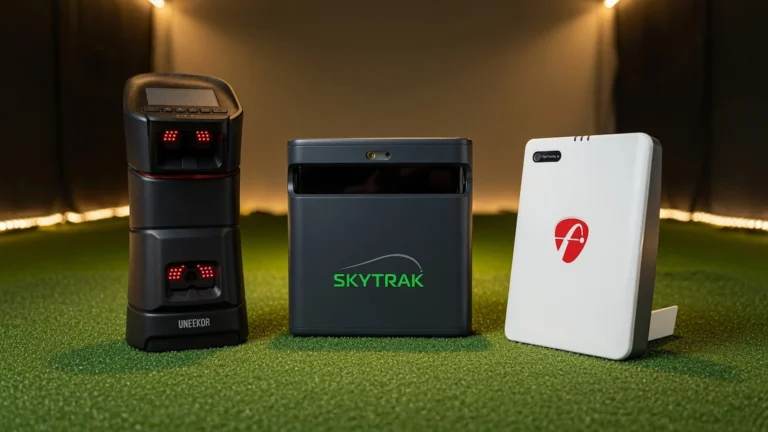
- Under $10,000: step up to Bushnell Launch Pro ($2,499, built on the Foresight GC3 engine) or Uneekor Eye Mini Lite with a SIG10 enclosure, ~$8,500 all-in.
- $15,000+: Trackman iO in a custom or SIG12 studio — $20,000+ territory for permanent installs.
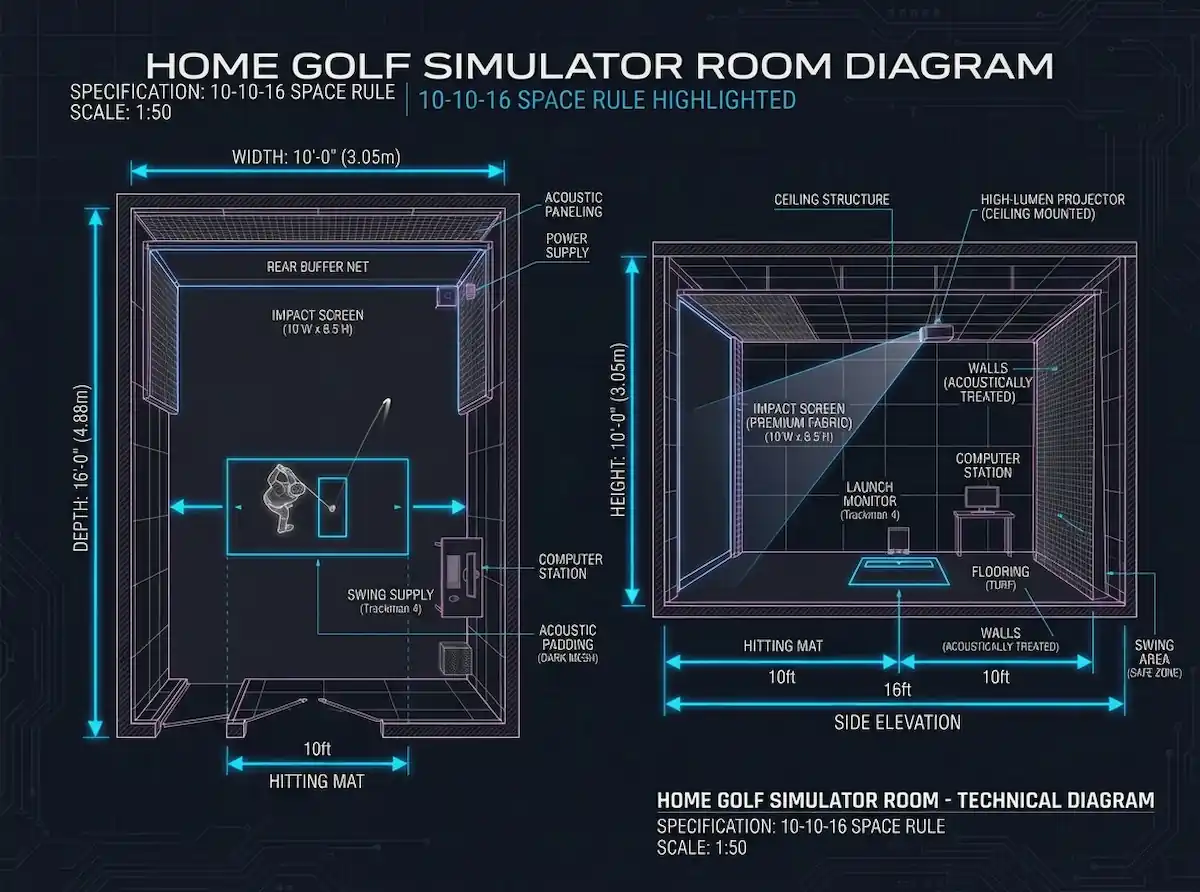
- Measure your room before you buy anything — the 10-10-16 rule (ceiling / width / depth in feet) decides radar vs. camera before price does.
The 2026 Home Simulator Setup Comparison
| Budget Tier | Best For | Launch Monitor | Enclosure / Impact Zone | Estimated Total Cost |
|---|---|---|---|---|
| Under $1,500 | Small spaces & strict budgets | Square Golf ($699) | Pop-up net & stance mat | ~$1,200 |
| The $5,000 Hero | The ultimate garage DIY build | SkyTrak ST MAX ($2,995) | DIY 3D Mesh Screen & EVVA Turf | ~$4,900 |
| Under $10,000 | Serious enthusiasts | Bushnell Launch Pro ($2,499) | SIG10 Enclosure & Premium Mat | ~$8,500 |
| $15,000+ | Luxury & permanent studios | Trackman iO ($14,000+) | Custom built-in / SIG12 | ~$20,000+ |
The Centerpiece: The Ultimate $5,000 Garage Setup (Best Overall)
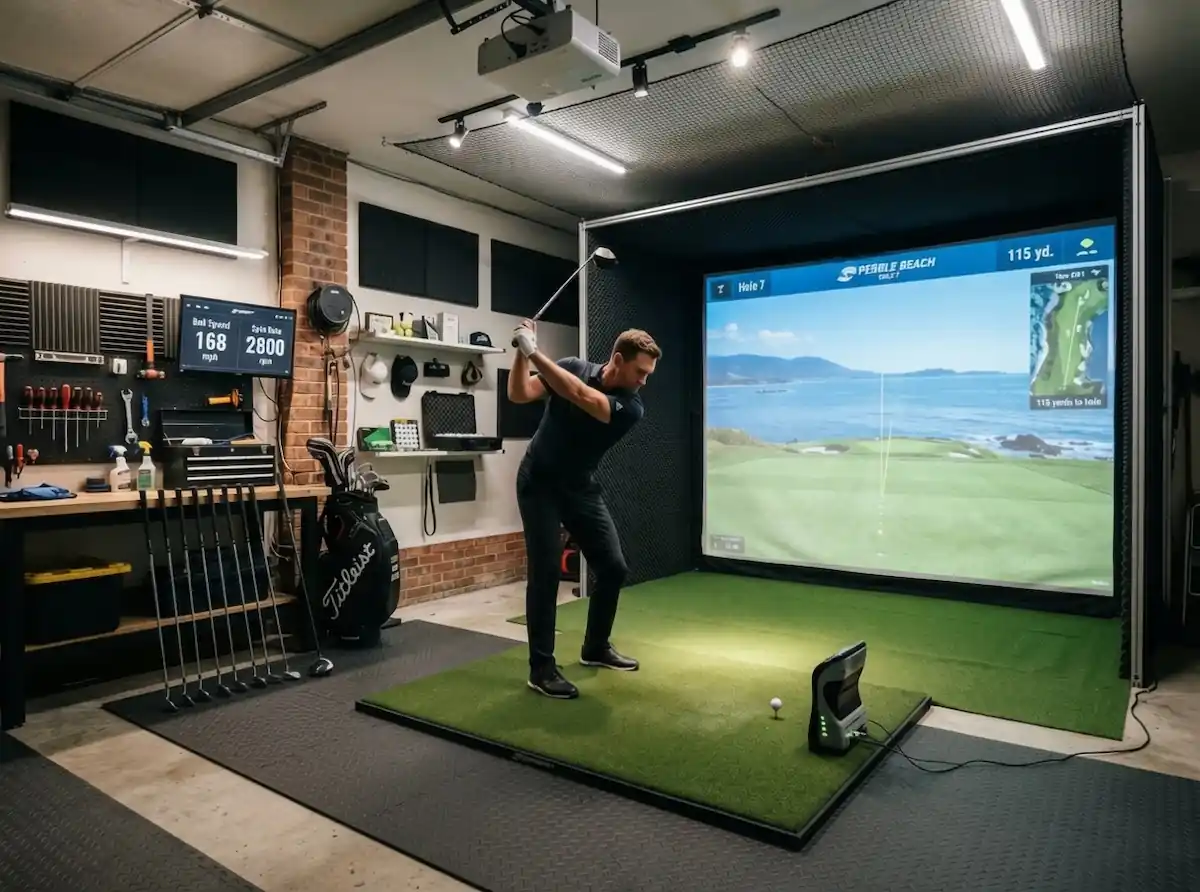
If you have $5,000, you do not need to compromise on data accuracy or visual immersion. You can build a 4K, hyper-accurate simulator that rivals commercial bays by refusing to pay the “golf tax” on enclosures and flooring. This is the setup we recommend to 90% of intermediate golfers.
The Brains: SkyTrak ST MAX ($2,995)
We are centering this build around the new SkyTrak ST MAX. Why? Because for the 8–18 handicap golfer, it provides the most user-friendly, comprehensive practice environment on the market. It uses dual Doppler radar paired with photometric cameras to deliver pinpoint accuracy that, in independent third-party comparisons, holds up incredibly well against reference units like the TrackMan 4. It features an upgraded processor for near-instant shot display, integrated speed training, and crucial club data metrics to help you fix your slice. Read our full SkyTrak ST MAX review here.
The Visuals & Computing ($1,400)
Because the SkyTrak software is uniquely optimized, you can actually run it natively on a Mac. However, to run third-party software like GSPro in stunning high definition, allocate $800 to a refurbished Windows gaming PC (look for an RTX 4060 graphics card or better) and $600 to a 1080p short-throw projector mounted safely out of your swing path.
The Enclosure & Flooring Hacks ($600)
Do not buy a $1,500 prefabricated metal enclosure. Use your garage walls. Anchor a triple-layer, sound-reducing 3D mesh impact screen directly to your ceiling using eyelets. For flooring, cover the ground in cheap EVVA foam puzzle gym mats topped with outdoor turf. Finally, buy a cheap stance mat, cut a hole in it, and insert a premium $40 hitting strip. This gives you a joint-saving, premium strike zone at a fraction of the cost.
The Verdict: For just under $5,000, you get professional-grade photometric accuracy, a massive projected image, and an injury-preventing mat. For a step-by-step breakdown of how to construct this exact room, read our comprehensive $5k Garage Golf Simulator Build Guide.
Once your room is built, do not fall into the trap of blindly bashing drivers into the screen. Put your new data to work immediately by following our 8-Week Structured Simulator Practice Program to guarantee your handicap drops before spring.
Best Budget Setup: The $1,500 Spare Room Build
If you don’t have the space or budget for a full 4K projector setup, you can still get highly accurate club and ball data using a hitting net and a tablet.
The Brains: Square Golf Launch Monitor ($699)
The budget launch monitor market exploded this year, but the Square Golf reigns supreme for indoor use. Because it is a purely optical (camera-based) system, it sits directly next to the golf ball. It requires almost zero room depth, making it vastly superior to radar units for tight spare bedrooms. Crucially, it requires zero forced annual subscription fees.
The Impact Zone ($500 – $800)
Pair the Square Golf with a high-quality pop-up net like The Net Return (which safely returns the ball to your feet) and a durable stance mat. You view your shots on an iPad or cast them to a TV mounted on the wall.
The Verdict: It lacks the visual majesty of hitting into a massive projector screen, but the data is legitimate. It is the perfect entry point for golfers who want to keep their swing grooved through the winter without breaking the bank.
Best Enthusiast Setup: The $10,000 Studio
When your budget approaches the $10,000 mark, you transition away from DIY hacks and into premium, prefabricated studio packages that look like they belong in a high-end commercial facility.
The Brains: Bushnell Launch Pro ($2,499) or Uneekor Eye Mini Lite ($2,750)
At this tier, we upgrade to tour-level photometric accuracy. The Bushnell Launch Pro (built on the Foresight GC3 engine) is widely considered the most accurate floor-standing unit under $3,000. It measures spin axis, launch angle, and club path with zero indoor limitations. Alternatively, the Uneekor Eye Mini Lite offers a phenomenal, screenless indoor-only experience with robust native software.
The Impact Zone: SIG10 Enclosure ($3,500+)
The Indoor Golf Shop’s SIG10 enclosure is the benchmark for enthusiast builds. It measures roughly 10 feet wide and features an incredibly durable, tightly tensioned impact screen that absorbs high-speed driver impacts effortlessly while delivering a crisp, bright image.
The Verdict: By pairing a Launch Pro or Uneekor with a SIG10 enclosure and a 4K gaming PC, you are getting 98% of the performance of a $30,000 commercial studio for a third of the price.
Best Premium Setup: The $20,000+ Luxury Studio
Money is no object. You want zero exposed wires on the floor, seamless transitions between left-handed and right-handed players, and uncompromising aesthetic beauty.
The Brains: Trackman iO ($14,000+) or Foresight Falcon ($15,999)
To get the launch monitor off the floor, you must invest in an overhead array. The Trackman iO fuses radar and infrared imaging into a ceiling-mounted unit designed specifically for indoor spaces. If you prefer photometric technology without an annual subscription fee, the Foresight Falcon packs GCQuad-level cameras into a sleek overhead mount. Curious how these giants compare to the mid-tier? Read our deep dive on TrackMan vs. SkyTrak MAX.
The Impact Zone: Custom Architectural Build ($5,000+)
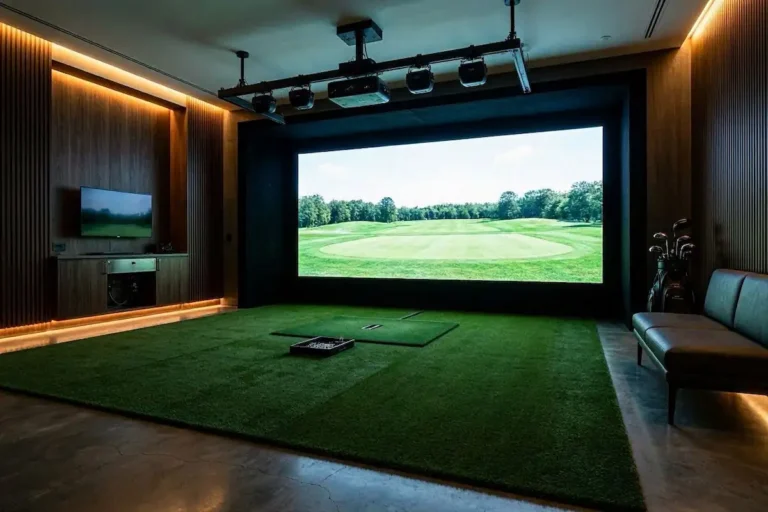
Rather than a freestanding enclosure, luxury builds utilize upholstered acoustic wall panels, flush-mounted impact screens that span wall-to-wall, and custom putting turf that integrates your hitting strip directly into the floor so there are no uneven surfaces.
The Verdict: This is the pinnacle of indoor golf. It is an architectural feature of your home that delivers absolute data perfection.
Key Buying Considerations for 2026
If you are sourcing your own parts, you must adhere to these three critical frameworks before clicking buy:
1. The 10-10-16 Space Rule
Do not guess your room dimensions. You need a 10-foot ceiling to swing a driver without psychological restriction (indoor swing syndrome). You need 10 feet of width to center the ball. If you buy a radar-based launch monitor (like the Garmin R10 or Mevo+), you need 16 feet of depth (8 feet to the screen, 8 feet behind the ball). If you lack depth, you must buy a camera-based system like the SkyTrak MAX or Square Golf.
2. The Software Ecosystem (GSPro)
Your launch monitor is only as good as the software it runs. In 2026, GSPro is the undisputed gold standard for simulator software, offering over 1,500 realistic, user-created courses and ultra-realistic ball physics. Ensure the launch monitor you buy officially supports a GSPro integration.
3. Accuracy Needs (Measured, Not Estimated)
For the 8–18 handicap player, carry distance is not enough. To actually improve, you must know your club path (in-to-out vs. out-to-in) and your face angle at impact. Ensure your chosen launch monitor directly measures—rather than estimates—these metrics.
Our Methodology
At XS Golf, our recommendations are built by synthesizing research rather than first-party testing. For each launch monitor and simulator we draw on manufacturer specifications, independent third-party testing (including published side-by-side comparisons against reference units like the TrackMan 4), and aggregated owner and reviewer reports — paying particular attention to how accurately each system reads mishits such as toe-strikes, heavy contact, and high-spin slices, since a simulator is only useful if it reads your bad shots too. We do not currently run a physical testing lab of our own; a first-party XS Golf testing program — including a structured shot protocol and a multi-handicap tester panel — is a commitment we’re building toward in 2026.
Sources: manufacturer specifications and pricing from SkyTrak, Square Golf, Bushnell, Uneekor, and Trackman product listings; published independent comparisons against reference units such as the TrackMan 4; and owner reports aggregated from r/Golfsimulator and GolfWRX forum threads, checked July 2026. Our full process is on the XS Golf Standards page.
The Final Takeaway
The best golf simulator is the one that fits your space, protects your joints, and gives you data you can trust. If you are a mid-handicapper looking for the ultimate intersection of value and performance in 2026, build a $5,000 garage studio around the SkyTrak ST MAX, invest in a quality hitting strip, and get to work.