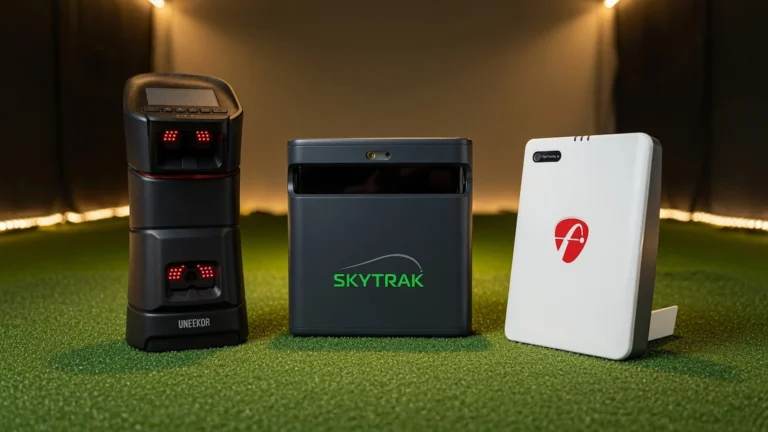
Rapsodo MLM2PRO vs. Square Golf vs. Swing Caddie SC4: The $700 Launch Monitor Shootout
Last updated: July 2026 — pricing and subscription terms checked against manufacturer listings.
There’s a bracket in the launch monitor market that causes more buyer paralysis than any other: the $600–$750 tier. It’s populated by devices that are genuinely good — not range-toy good, not “just buy a Garmin R10 and move on” good, but real instruments with real data. The problem is they’re not interchangeable. Radar vs. optical camera. Subscription vs. no subscription. Works indoors vs. outdoor-only. The spec sheets won’t tell you which one fits your setup. This article will — and because subscriptions are the biggest hidden cost here, our 3-year cost of ownership analysis shows how they add up.
We’ve already covered the broader sub-$1,000 field in our launch monitors under $1,000 roundup. This goes narrower. Three devices, same price point, very different answers. If you’re building a simulator room, the space question alone could make this decision for you — see our simulator build guide for room depth requirements before you buy anything.
Quick Verdict
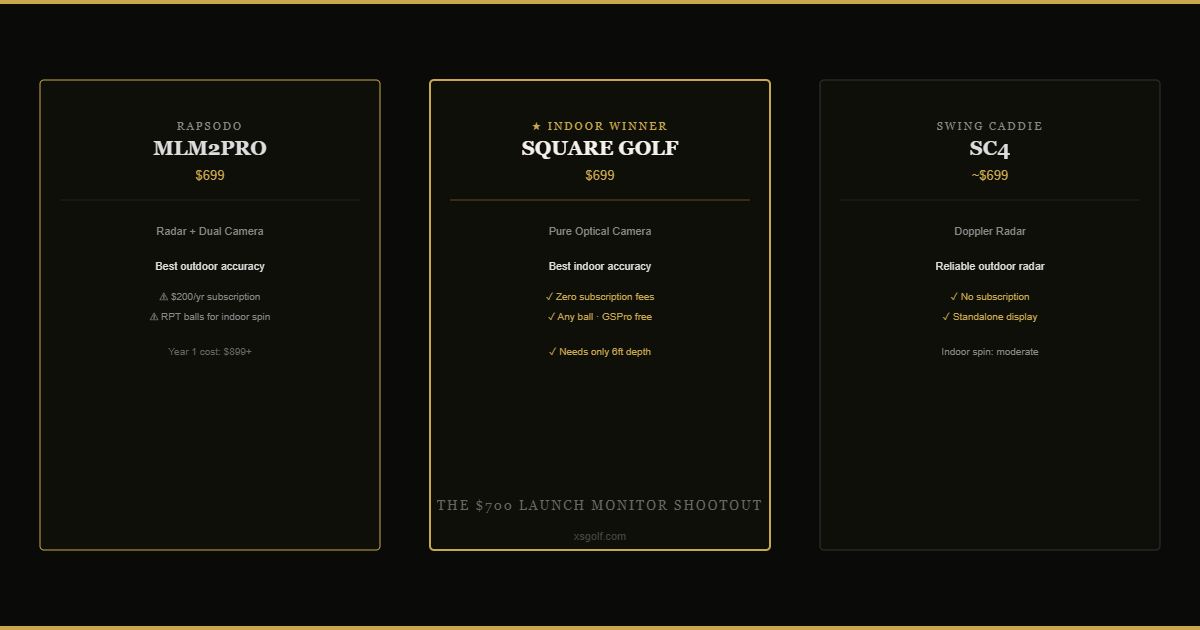
CATEGORY RAPSODO MLM2PRO SQUARE GOLF SC4 Accuracy (outdoor) ✓ Excellent ★ Not designed for Good Accuracy (indoor) Needs RPT balls ✓ Excellent Moderate Space required 10–12 ft depth min ✓ 6–7 ft depth 10–12 ft depth min Subscription fees $200/yr or $599 life ✓ None (credits only) None Software ecosystem Native + limited 3rd ✓ GSPro, E6 free Native + GSPro Total cost (yr 1) $899–$1,298 ✓ $699 ~$699–$750 Best use case Range / outdoor Indoor simulator Range / outdoor OVERALL WINNER Outdoor pick ★ INDOOR WINNER Budget outdoor xsgolf.comKey takeaways
- Indoor simulator → Square Golf. Optical tracking that works from 6 feet of depth with any ball, no subscription, and free GSPro/E6 integration — but it is indoor-only. Three-year cost of ownership: roughly $789–$849.
- Outdoor or mixed use → Rapsodo MLM2PRO. Radar plus dual cameras with the best outdoor data in the bracket; indoors it needs RPT balls and more depth, and subscriptions push the three-year total past $1,500.
- Simplest purchase → Swing Caddie SC4. Portable radar with a built-in display and no subscription — the lowest-friction option if you just want numbers at the range.
- All three list near $699; the real separator is three-year cost and your space, not the sticker price.
The Devices: Individual Profiles
Rapsodo MLM2PRO — $699
The MLM2PRO uses a hybrid approach: Doppler radar combined with dual high-speed cameras. In theory, this gives you both the ball-flight data of radar and the face/spin imagery of optical. In practice, it’s the best outdoor launch monitor at this price point, and a conditionally acceptable indoor option with a significant asterisk.
What it measures: Ball speed, club speed, smash factor, launch angle, spin rate, spin axis, carry distance, total distance, shot shape. The dual camera captures face angle at impact and provides a visual shot trace. The data quality outdoors, with sufficient ball flight, is genuinely excellent — comparable to monitors costing twice as much.
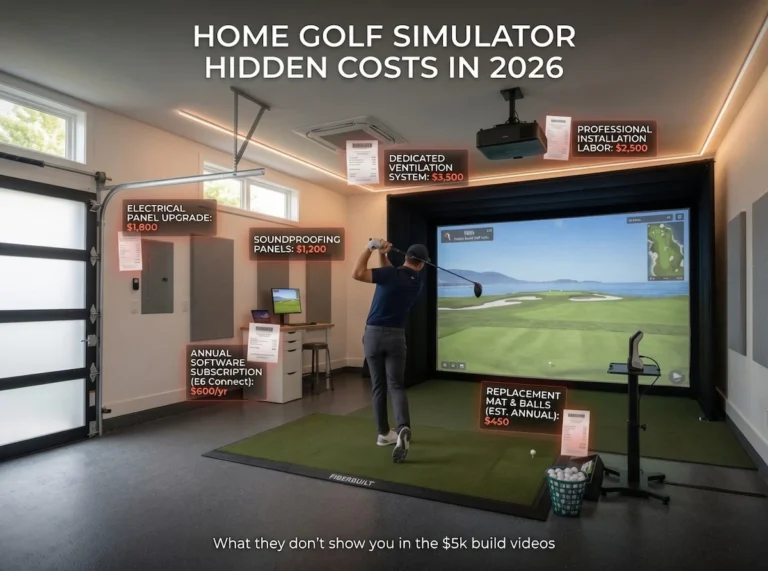
The hidden cost problem. The device costs $699. But the device alone doesn’t give you everything the marketing implies. To unlock Premium features — specifically video capture, advanced data analytics, and full simulation integration — you need a Rapsodo Premium Membership. That’s $199.99 per year, or $599 as a lifetime purchase. Year-one cost: $899 minimum, $1,298 if you buy the lifetime sub upfront. This is not disclosed prominently at point of sale. Know it before you buy.
The indoor spin problem. Radar works by tracking ball flight. In a short indoor bay where the ball travels 8–10 feet before hitting a screen, there isn’t enough flight data to accurately calculate spin rate. Rapsodo’s solution is RPT (Radar Performance Technology) balls — specially marked balls that give the radar additional spin data. These work. They cost roughly $45–$60 per dozen and cannot be substituted with regular Titleist or Callaway balls for accurate indoor spin readings. If you’re building a simulator and expect accurate spin data indoors, budget for RPT balls as an ongoing cost.
Outdoor verdict: Excellent. The best camera-radar hybrid at this price. If you’re a range golfer who wants premium data on outdoor sessions, this is your pick.
Square Golf Launch Monitor — $699
Square Golf uses a purely optical system: high-speed cameras positioned in front of the ball, capturing the moment of impact and early ball flight. No radar. No special balls. No subscription.
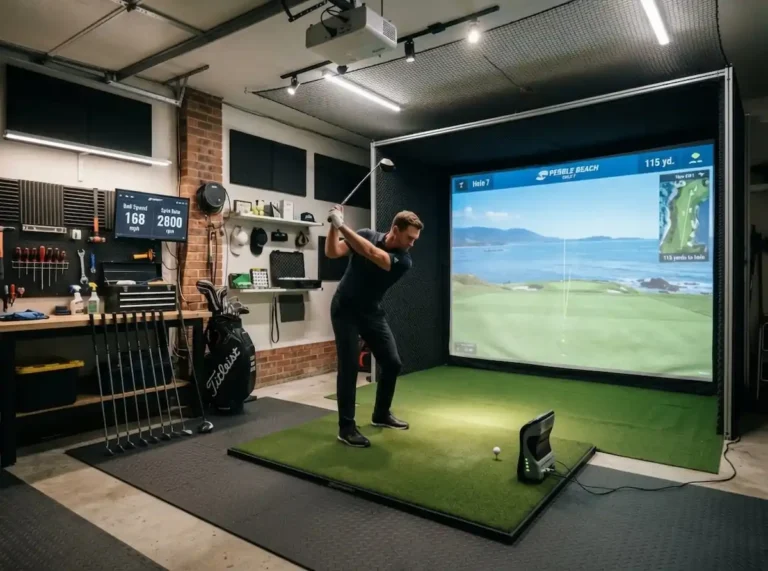
What makes it different: It sits in front of the ball rather than beside or behind it, which means the device itself only needs about 6–7 feet of room depth to function — compared to the 10–12 feet that radar systems require for reliable readings. In a converted spare bedroom or garage bay where depth is the constraint, this isn’t a minor advantage. It’s often the deciding factor. See our full breakdown of room depth requirements in the simulator build guide.
Accuracy: In the indoor spaces it’s designed for, Square Golf’s optical system produces highly accurate club speed, ball speed, launch angle, and spin data. Because it’s capturing physical impact rather than inferring spin from ball flight, it doesn’t need special balls and doesn’t degrade with room depth. Any premium golf ball works.
The subscription-free model: Square Golf has no annual fee. The native simulation platform uses a credit system for course access — inexpensive, pay-as-you-go — but the headline integration is that it connects freely to GSPro and E6 without an additional subscription. If you’re already planning to run simulation software on a dedicated PC, Square Golf may be the lowest total-cost-of-ownership option in the entire sub-$1,000 bracket.
The outdoor limitation: This is an indoor-only device. It requires a stable camera environment — consistent lighting, controlled background. It doesn’t work on a driving range. If outdoor use matters at all to you, this isn’t your device.
Indoor verdict: The best pure indoor launch monitor under $700. Lowest total cost of ownership in the category. Space-constrained simulator builds should strongly consider this over every radar alternative.
Swing Caddie SC4 — ~$699
The SC4 is the fourth generation of Voice Caddie’s popular portable radar line. It’s a known quantity: reliable, well-supported, and the product of a company that has iterated meaningfully on the same platform for several years.
What it measures: Ball speed, club speed, smash factor, launch angle, carry and total distance, shot shape (left/right), and — with its onboard display — it provides readings without requiring a phone connection. The dedicated display is a genuine differentiator for range use: no phone to fiddle with, no connectivity issues, readings appear immediately on the device.
App experience: The SC4 companion app is functional but not exceptional. It logs sessions, tracks club performance over time, and provides a basic shot shape overlay. It doesn’t have the visual depth of Rapsodo’s dual-camera system or the simulator integration reach of Square Golf’s GSPro connection. It integrates with GSPro, which expands its usefulness for simulator setups significantly.
Accuracy context: As a radar device, the SC4 shares the same indoor limitations as the MLM2PRO — spin accuracy degrades at short indoor distances. Outdoors, it’s accurate and reliable across ball speed and carry distance. Spin numbers are less trustworthy indoors without special balls.
Where it sits: The SC4 is the pragmatist’s outdoor radar. No subscription, standalone display, proven track record. It doesn’t win any single category decisively against the MLM2PRO or Square Golf, but it’s the lowest-friction purchase of the three — fewer surprises, no hidden costs, works out of the box.
Direct Head-to-Head
Accuracy and Technology: Radar vs. Camera
The fundamental technical split in this bracket is radar versus optical camera, and it matters more than any spec-sheet comparison.
Radar systems — including both the MLM2PRO and SC4 — calculate spin by measuring the rate of change in the ball’s rotational velocity as it travels through the air. This requires actual ball flight. In an outdoor environment with 50+ feet of ball travel before any obstruction, radar produces accurate, stable spin readings. In an indoor simulator bay where the ball hits a screen after 8–12 feet, there simply isn’t enough flight data for the radar to calculate spin reliably. The numbers it returns are interpolated estimates, not measurements.
Optical camera systems like Square Golf capture the physical contact event itself — the deformation of the ball at impact, the dimple pattern rotation in the first milliseconds of flight. Spin is measured directly, not inferred. Room depth is irrelevant. This is why high-end commercial simulators (Trackman, Foresight GC series) have historically used camera or combined camera-radar systems: they work reliably in the tight spaces where simulators live.
At $699, Square Golf brings this optical advantage to a consumer price point that wasn’t available two years ago. That’s the actual news in this bracket, and it’s the reason this comparison exists.
Radar vs. Camera — Where Each Works SCENARIO RADAR (MLM2PRO / SC4) OPTICAL (SQUARE GOLF) Outdoor range (50+ ft ball flight) ✓ Full accuracy ✗ Not designed for this Indoor sim bay (8–12 ft ball flight) ⚠ Spin degraded (needs RPT balls) ✓ Full accuracy, any ball Space-constrained room (6–8 ft depth) ✗ Insufficient flight data ✓ Works from 6 ft Mixed use (range + occasional sim) ✓ Best option here ✗ Not outdoor-capable xsgolf.comTotal Cost of Ownership
The sticker price comparison is misleading. Here’s what each device actually costs over three years of ownership for a typical indoor simulator user:
Rapsodo MLM2PRO: $699 device + $199/yr Premium Membership + RPT balls (~$100/yr for regular indoor use) = $699 upfront, then ~$299/yr ongoing. Three-year total: approximately $1,595. Or $699 + $599 lifetime sub + RPT balls = $1,598 upfront. Either way, you cross $1,500 within three years.
Square Golf: $699 device. Course credits for native platform add maybe $30–$50/yr depending on usage. GSPro integration is free. Three-year total: approximately $789–$849. That’s a ~$750 difference over three years compared to a subscribed MLM2PRO. You could buy a second Square Golf unit and still spend less.
Swing Caddie SC4: ~$699 device. No mandatory subscription. GSPro integration available. Three-year total: approximately $699–$749. Lowest total cost of ownership of the three, but also the weakest indoor spin data.
The Honest Recommendation
Buy the Square Golf if: You’re building an indoor simulator
If your primary use is a dedicated simulator bay — whether that’s a garage, basement, or spare room — Square Golf is the correct answer at this price point. It’s more accurate indoors than any radar alternative. It doesn’t require special balls. It has no subscription fees. It connects freely to GSPro and E6. The optical technology that was previously only available at $1,500+ is now at $699.
The only reason not to buy it for indoor use is if your ceiling height is too low for the camera placement (check Square Golf’s specifications for minimum ceiling clearance) or if you also want outdoor range functionality — in which case you need a different tool entirely.
Buy the Rapsodo MLM2PRO if: You primarily use the range and want premium data
The MLM2PRO is the best outdoor launch monitor in this price tier. The hybrid radar-camera system delivers accurate spin, face angle, and shot shape data that the SC4 doesn’t match. If you practice primarily outdoors and want video-backed shot analysis alongside your launch data, the MLM2PRO earns its premium — including its subscription.
Go in eyes open on the costs. Budget for Premium Membership from day one. Don’t be surprised by the RPT ball requirement if you ever use it indoors. And know that the $699 sticker is the beginning of the transaction, not the end.
Buy the SC4 if: You want reliable outdoor radar with no surprises
The SC4 is the pragmatist’s choice. No subscription, standalone display, proven accuracy outdoors. It doesn’t have the MLM2PRO’s video capability or Square Golf’s indoor optical advantage, but it’s the most straightforward purchase of the three. If you want a capable range radar that connects to GSPro for occasional simulator use, the SC4 is a clean, honest device.
Who Should NOT Buy Any of These
This bracket isn’t for everyone. Three scenarios where you should spend differently:
You just want basic speed and carry data: The Shot Scope LM1 at $199 does this reliably. It’s not a simulator device — it has no spin data, no course integration, no face angle. But if you’re a range golfer who wants to know how far you actually carry a 7-iron, $199 gets you that without overpaying by $500.
You want a premium outdoor radar for serious fitting or coaching: Save to $1,299 and buy the FlightScope Mevo Gen 2. The accuracy jump from any $700 device to the Mevo Gen 2 is substantial, particularly for spin loft, dynamic loft, and angle of attack data. If you’re using this professionally or for serious swing coaching, this bracket isn’t accurate enough.
You want optical accuracy that also works outdoors: Wait for the Square Golf Omni, currently priced around $1,599. Square Golf’s roadmap includes an outdoor-capable optical system. If you need both indoor precision and outdoor capability from one device, that’s your answer — but it’s not in this bracket yet.
Final Rankings
Final Rankings by Use Case INDOOR SIMULATOR Square Golf Optical · No sub · GSPro free Space-efficient ★ TOP PICK OUTDOOR / HYBRID MLM2PRO Radar+Camera · Best data Budget: $899+ yr 1 OUTDOOR PICK BUDGET / CLEAN SC4 Radar · No sub · Display Lowest friction purchase PRAGMATIST PICK xsgolf.comIf you’re undecided between this bracket and stepping up to devices like the Foresight GC3 or Trackman iO, our full sub-$1K roundup covers the complete picture including the Garmin R10 and the Flightscope Mevo series. The simulation software that runs on top of any of these devices is covered in our simulator software guide.
Sources & how we put this together
This comparison is based on manufacturer specifications and published pricing from Rapsodo, Square Golf, and Voice Caddie product listings; subscription terms from each maker’s published plans; and owner reports aggregated from r/Golfsimulator and GolfWRX forum threads. Figures were checked in July 2026 and change often — confirm current pricing before you buy. It does not describe first-party robot or launch-monitor testing; a lab, tester panel, and re-test policy are commitments we’re building out from 2026 forward, and we won’t imply results we don’t have. Our full process is on the XS Golf Standards page.