Golf Short Game Tips That Save Strokes: Chipping, Pitching, Bunkers and Putting
Last updated: October 8, 2026
Most intermediate golfers practice the shots that feel good to hit and skip the ones that cost them pars. This guide covers the four short-game jobs that decide most up-and-downs (chipping, pitching, bunker play and putting) plus a practice split you can run in 30 to 60 minutes, at the range or at home.
Quick Verdict
Pick the lowest-risk shot, preset your contact, and practice to targets
- Shot choice: putt if you can, chip if you can’t putt, pitch only when you have to carry something. Flops are a last resort.
- Chipping: narrow stance, weight on the lead foot, hands ahead, a rocking stroke with quiet wrists.
- Pitching: backswing length sets the distance; the through-swing never slows down.
- Bunkers: open the face, enter the sand 1–2 inches behind the ball, swing to a full finish.
- Putting: most of your practice time, split between makes inside 6 feet and lag putts from 20–40 feet.
Technique points reflect widely taught coaching fundamentals. XS Golf did not run its own player trials for this guide.
Why the short game is the place to start
Two well-known pieces of research point in different directions here, and both are useful.
Short-game coach Dave Pelz concluded that more than 60% of golf shots are played from within about 100 yards of the hole. That is the volume argument: most of the swings you make in a round are short ones.
Columbia Business School professor Mark Broadie, who developed the strokes-gained method, found the opposite when it comes to what separates players. In his analysis of PGA Tour players, shots from outside 100 yards accounted for about 72% of the variation in total strokes gained, with the short game at about 11% and putting at about 17%. Those figures describe Tour pros, not amateurs, but the direction is clear: ball-striking separates players more than chipping does.
So why start here? Because the short game is where an hour of practice buys the most. You can work on it in a backyard, a garage or a hallway. The feedback is immediate. And the strokes it removes are the cheap ones: the duffed chip, the bunker shot that stays in, the three-putt. Broadie’s same paper found that golfers who average around 90 three-putt roughly four times as often as Tour players. You don’t need a new swing to fix that.
The same strokes-gained logic works for a whole round. Our guide to expected golf scores by handicap shows how to turn your Index, Course Rating and Slope into the score a normal day should produce.
Start with the lowest-risk shot
Pick the simplest option that still gets the ball near the hole.
- Putt from the fringe or just off the green whenever the path is clear. A hybrid or 7-iron “putt” (hands down the grip, quiet wrists, brushing the grass) often beats a lofted chip from a tight lie.
- Chip (low flight, mostly roll) when you can’t putt but have green to work with.
- Pitch only when you must carry a bunker, a ridge or rough, or need the ball to stop quickly.
- Flop or other high, soft shots are the last resort. More loft means a bigger penalty for a mishit.
Club choice follows the same logic. With the pin back and open green in front of you, take less loft: an 8- or 9-iron bump-and-run. For medium carry and roll, move to a pitching or gap wedge. Save the sand or lob wedge for shots that really need height and spin. Learn one landing spot per club and how far the ball releases from it, and most of the guesswork goes away.
Chipping: a setup that produces ball-first contact
Thin and chunked chips usually come from the same three setup errors: weight back, hands behind the ball, and a flick of the wrists at impact.

- Narrow stance, ball slightly back of center.
- Roughly 60–70% of your weight on the lead foot, a common coaching guideline, and keep it there through the stroke.
- Hands slightly ahead of the ball so the shaft leans toward the target. That encourages a descending strike.
- Rock the shoulders, much like a putting stroke, with very little wrist hinge. Keep accelerating through impact.
Aim at a landing spot a few yards onto the green, not at the hole. Once the ball is rolling it behaves like a putt, so read the green the same way. A good drill: one club, three landing spots. You learn how carry and roll change with the spot instead of changing your technique for every distance.
Pitching: swing length controls distance
The classic mistake is a long backswing followed by a slowdown into the ball. You get chunks, thins and spin you can’t predict.

- Use the most loft that still lets you make a reasonably full-feeling swing for the distance.
- Set distance with backswing length (hands to hip, chest or shoulder height). The through-swing is at least as long, and it accelerates.
- Ball near center, a little forward shaft lean, weight favoring the lead side and staying there.
- Body rotation supplies the speed. The wrists hinge naturally but don’t flip at the bottom.
Build a ladder: targets at fixed yardages, three balls each, same club, only the backswing length changes. That gives you the 20-to-60-yard distance chart most amateurs don’t have. A laser rangefinder makes setting those targets on a practice ground quick and exact.
Bunker shots: hit the sand, not the ball
Greenside bunker trouble is usually a contact problem before it’s a distance problem.
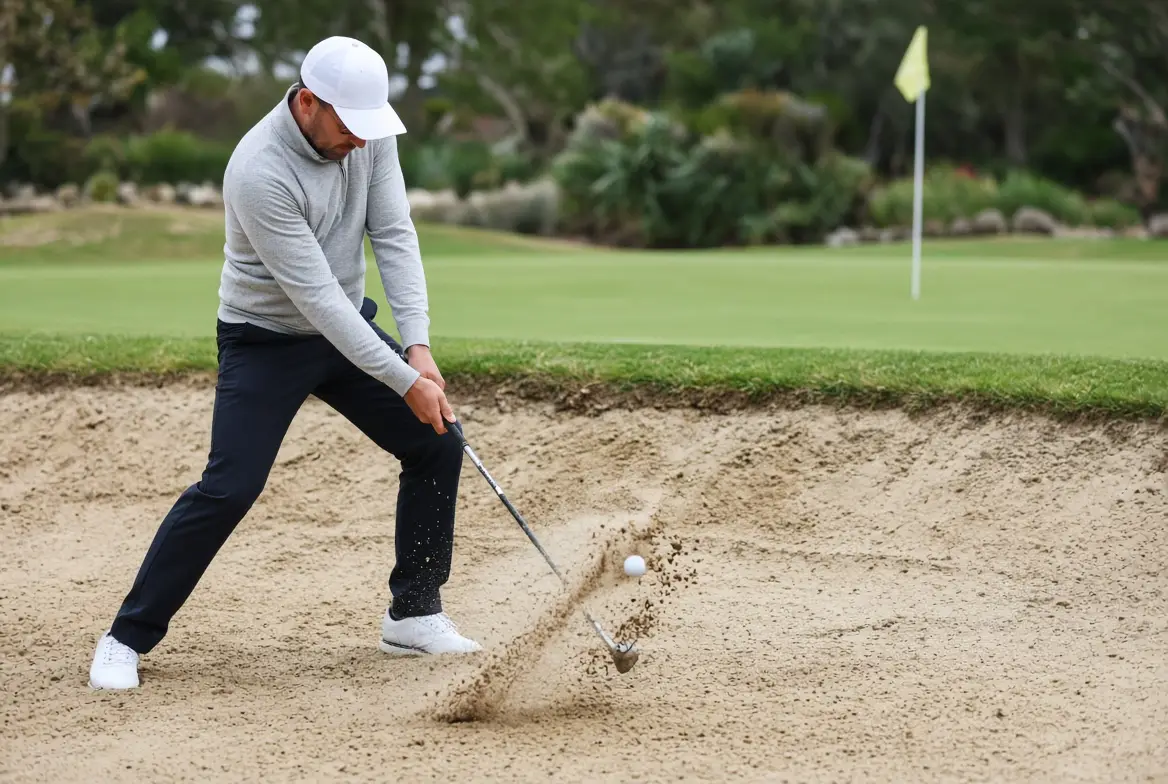
- Open the clubface first, then take your grip. Open your stance until the face points at the target.
- Ball slightly forward. Work your feet into the sand for a stable base.
- Enter the sand 1–2 inches behind the ball. The sand launches the ball, not the clubface.
- Swing through to a full finish. A follow-through longer than the backswing keeps the club moving and the ball out of the bunker.
Get out every time first. Once that’s reliable, control distance by changing swing length while keeping the same entry point in the sand.
Putting: protect the short ones, kill the three-putts
Every hole ends on the green, and as Broadie’s numbers above show, 90-shooters three-putt far more often than Tour players. That’s why putting gets the biggest share of the practice plan below.

- Make putts inside 6 feet your priority. They turn decent chips into pars.
- Lag from 20–40 feet with one goal: leave it inside a tap-in circle.
- Quiet lower body, shoulders rocking, eyes over the ball or just inside the line. Tempo matters more than mechanics.
If your putter fights your stroke, browse our putter reviews, including the Cleveland HB Soft 2.
A practical practice split
For a 30–60 minute session, this is a sensible starting split. It’s a rule of thumb, not a figure from a study. Shift it toward whichever part of your game costs you the most.
- 40–50% putting (short putts plus lag putts)
- 20–25% chipping from different lies to specific landing spots
- 15–20% pitching to set yardages
- 10–15% bunker work (or add it to chipping if you don’t have a bunker)

Putting and chipping both work at home. A carpet putting track or alignment sticks handle path; a towel or mat target gives you a chipping landing spot. For pressure on short putts, see our PuttOut Pressure Trainer Pro review and the wider tech and training aids section.
Full wedge gapping is where a launch monitor earns its place, because carry numbers remove the guesswork you’d otherwise carry onto the course. Our guide to launch monitors under $1,000 and the budget launch monitor shootout cover the options. If you already own a simulator, the 8-week simulator practice program shows how to fold wedge work into a weekly plan.
To find out where your strokes actually go, track up-and-down and putting stats for a few rounds. A shot-tracking system like Arccos Caddie logs it through club sensors; a notebook works too.
Gear notes that matter here
Ball cover. In MyGolfSpy’s testing, urethane-covered balls averaged about 5,400 rpm on a 35-yard wedge shot against about 3,500 rpm for ionomer covers, and the gap grew on wet full wedges. The same testing found big differences between individual urethane models, and at least one ionomer ball outspun a urethane ball on a dry full wedge. Cover type is a good starting point, not a guarantee. Our golf ball comparison and fitting guide goes ball by ball.
Wedge bounce and grind. These often matter as much as an extra degree of loft. More bounce helps from soft sand and fluffy lies; less bounce suits tight, firm turf. A fitting is the quickest way to match bounce to your turf and swing. Our club fitting guide for intermediate golfers explains what to ask for.
Set makeup. A pitching, gap and sand wedge with known carry distances beats a specialty lob wedge you rarely strike cleanly. For the rest of the bag, see the best golf clubs for intermediate players.
How this guide was put together
XS Golf did not physically test anything for this guide or run its own player trials. The technique advice reflects fundamentals that are widely taught by golf coaches. Statistics are attributed to their sources where they appear: Dave Pelz’s short-game work, Mark Broadie’s strokes-gained research on PGA Tour players, and MyGolfSpy’s golf ball spin testing. See the XS Golf standards page for how we research and update content.
Short game FAQ
What percentage of golf shots are in the short game?
Short-game coach Dave Pelz concluded that more than 60% of shots are played from within about 100 yards of the hole. Mark Broadie’s strokes-gained research on PGA Tour players found that longer shots explain more of the difference between players, so the short game holds most of the shots but not most of the separation.
Should I chip or putt from the fringe?
Putt when the path is clear and the grass between you and the green is short. It is the lowest-risk option. Chip when you can’t putt but have green to roll the ball on, and pitch only when you need to carry something or stop the ball quickly.
How far behind the ball should I hit the sand in a bunker?
A common coaching guideline is 1–2 inches behind the ball, with an open clubface and a swing that continues to a full finish. The sand launches the ball, so clean contact with the ball itself is what you want to avoid.
How should I split short-game practice time?
A sensible starting point is 40–50% putting, 20–25% chipping, 15–20% pitching and 10–15% bunker work. This is a rule of thumb rather than a research figure. Adjust it toward whichever part of your game costs you the most strokes.
Bottom line
Simplify your shot choice, set up for the contact you want before you swing, and practice distance control to targets instead of beating balls at nothing. Ball-striking still separates players most, but the short game is where a few focused hours a month can take strokes off your next round.