GolfZon vs. Trackman, Foresight, aboutGOLF & Full Swing: How Each Brand Handles the Tee Box (2026)
Last updated: July 27, 2026
If you’ve played at a golf bar or studio and never once bent down to re-tee a ball, you were almost certainly on a GolfZon. That single convenience — an auto-tee that feeds and tees each ball at a pre-set height — paired with a hydraulic moving swing plate that tilts to match the previous shot’s lie, is one of the clearest hardware dividing lines in the commercial simulator space. It matters for home builders too, even if the full GolfZon hardware isn’t realistically on most people’s shopping list.
This guide compares how the major brands handle the tee box, based on official manufacturer pages, technical documentation, and third-party cost sources as of mid-2026. Where sources conflict or a claim traces back to one brand’s own marketing about its competitors, we say so directly.
Quick Comparison
| Brand | Native Auto-Tee + Moving Plate? | Left/Right Handling | Primary Market | Hardware Starting Price (approx.) |
|---|---|---|---|---|
| GolfZon (Vision / TwoVision) | Yes — proprietary auto-tee, hydraulic moving plate, multi-surface mats | Commercial configs support both; some models offer dual-plate bays | Commercial bars/lounges + residential | From ~$21,300 |
| Trackman iO / iO DUO | No native auto-tee found in product documentation | Strong — iO DUO supports narrow (10 ft) bays for mixed right/left groups | Premium commercial + high-end home | From ~$13,995 (monitor only) |
| Foresight Sports (GCQuad and similar) | No native auto-tee found in product or dealer documentation | Standard mat setups; double-sided mats available from some dealers | Commercial + serious home | Varies by package |
| aboutGOLF | No auto-tee found in current documentation we reviewed | Standard | Premium home + commercial entertainment | Varies |
| Full Swing | No auto-tee found in current documentation we reviewed | Standard | Home + commercial | Varies |
Prices are approximate hardware starting points pulled from manufacturer sites and 2026 cost guides as of mid-2026 — they change, and full commercial installs (enclosure, flooring, integration) add substantially more. Verify current figures with an authorized dealer before budgeting.
What Auto-Tee and the Moving Swing Plate Actually Do
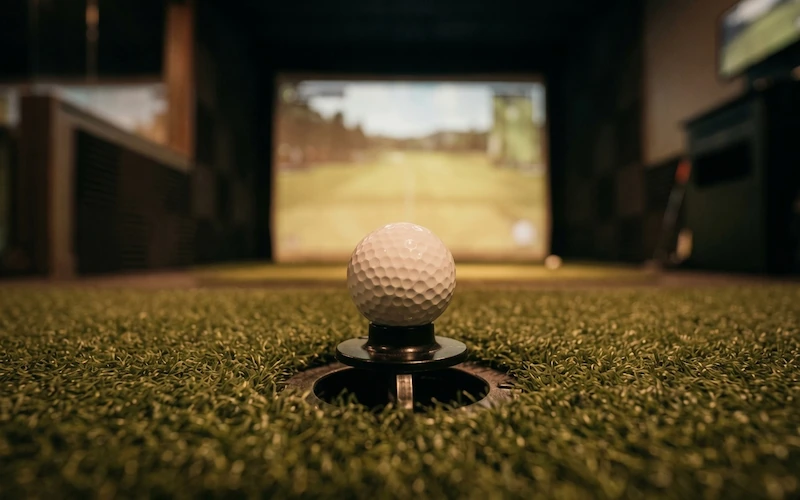
GolfZon’s auto-tee feeds and tees the next ball automatically at a height the platform remembers per player. The hydraulic moving swing plate tilts to replicate uphill, downhill, and sidehill lies based on where the previous shot landed, and interchangeable or multi-textured hitting surfaces (fairway, rough, bunker) add short-game realism.
On exactly how many slope positions the current plate offers, GolfZon’s own materials aren’t fully consistent with each other. Its current technology page cites 14 slope angles for the latest system. Older copy on GolfZon’s own site describes an earlier five-segment design capable of roughly 100 slope combinations, and at least one authorized dealer’s page lists a 24-position plate without naming the model. The honest summary: current GolfZon systems offer somewhere over a dozen distinct slope positions, and the exact number depends on which model and software generation you’re looking at — confirm the spec for your specific unit with a GolfZon dealer rather than treating any single number as universal.
Brand by Brand
GolfZon — the only major brand we found with auto-tee, a moving hydraulic plate, and multi-surface mats standard across much of its commercial and residential lineup. GolfZon’s own comparison materials claim it’s the only one of the brands below offering auto-tee at all; we independently checked Foresight’s own product and dealer pages and found nothing contradicting that for Foresight specifically. For aboutGOLF and Full Swing, we relied on GolfZon’s competitor claims plus an absence of contradicting evidence on those brands’ own sites — a thinner basis than the Foresight check, so treat it as likely rather than fully independently confirmed.
Trackman (iO / iO DUO) — built around dual radar-and-camera tracking and ceiling-mounted hardware. iO DUO is notable for handling mixed right- and left-handed groups in bays as narrow as 10 feet via dual monitors and automatic profile switching. No auto-tee or moving plate appears in Trackman’s product or setup documentation.
Foresight Sports (GCQuad and similar) — photometric camera-based tracking, widely used in fitting and commercial settings. We reviewed multiple Foresight and authorized-dealer product pages directly and found no mention of auto-tee; some dealers offer double-sided mats for mixed-handed groups instead.
aboutGOLF and Full Swing — both focus on their own launch monitor and software ecosystems with standard hitting surfaces. We found no auto-tee feature described in current materials for either, though this check leaned more on GolfZon’s competitive claims than on a page-by-page audit of each brand’s own site.
Mid-tier home brands (Uneekor, SkyTrak+, and similar) — dominate value-focused home and garage builds on data quality and price. None offer native auto-tee; owners who want it rely on aftermarket add-ons.
Why the Tee Box Matters
Commercial bars, lounges, and studios: auto-tee and a moving plate speed up play noticeably — less bending means faster bay turnover, which matters directly to hourly revenue. Mixed left/right groups are common in social settings; GolfZon’s commercial configurations are built to support both, while Trackman’s iO DUO stands out for handling tight bays with two players via software profile switching rather than a moving floor.
Home and garage builders: the appeal is mostly accessibility — players with back or joint issues, or anyone hitting 100+ balls in a session, get a real quality-of-life upgrade from not bending over every shot.
The purist counter-argument: some instructors and serious players prefer manually placing the ball, arguing that a perfectly fed, perfectly leveled ball can feel easier than real, variable lies and may not build the same course-transfer skill. That’s a reasonable position, particularly for low-handicap players focused on iron and short-game feel — auto-tee systems optimize for volume and convenience, not necessarily for practice realism.
Ownership Realities Worth Knowing
Mechanical convenience adds mechanical parts. A few things to factor in before committing to a moving-floor, auto-tee system, commercial or residential:
- Maintenance and jamming: ball feeders can jam from debris, and hydraulic plates have more failure points than a static mat. Commercial operators should plan for occasional downtime and a service contract.
- Mat wear concentration: a static hitting strip can usually be rotated or flipped as it wears. An integrated auto-tee mat has a fixed mechanism location, so wear concentrates in one spot rather than spreading across a rotatable strip — our read is that this likely makes replacement components more specialized (and probably pricier) than a generic strip, though we don’t have verified per-unit replacement costs to cite.
- Downtime impact: in a high-volume venue, even a few hours of a bay being down costs real revenue. A simpler ceiling-mounted or static setup has fewer things that can fail.
None of this is a deal-breaker — it’s worth discussing service response times and parts availability with a dealer before buying, especially for commercial installs.
Adding Auto-Tee to a Non-GolfZon Setup
If you prefer Trackman, Foresight, Uneekor, SkyTrak+, or Full Swing for data quality or price but still want the auto-tee convenience, none of those manufacturers currently offer it natively. Two aftermarket paths exist:
- Power Tee — an established auto-tee system with a long track record at commercial driving ranges, built for high-volume use.
- Drop Tee — a newer, compact drop-in auto-tee designed to fit into existing hitting mats with minimal modification. As of mid-2026, Drop Tee’s own site describes its units as still in final durability, reliability, and waterproofing validation, with new orders taken via waitlist rather than open sale — so this is a product to watch rather than one you can necessarily buy and install this month. Confirm current availability directly before planning around it.
GolfZon remains the turnkey option if you want the full moving-plate-plus-auto-tee experience without retrofitting.
Cost Context
Approximate hardware starting points as of mid-2026: GolfZon residential/light-commercial entry runs from roughly $21,300, with premium TwoVision models reported in the $55,000–$90,000 range plus $2,000–$4,000 in annual maintenance, per a third-party 2026 simulator cost guide. The same source put Trackman iO home packages starting around $13,995 for the monitor alone, before enclosure and installation. These are list-price snapshots, not current dealer quotes — verify directly before budgeting, and see our total cost of ownership guide for a fuller multi-year picture.
How We Researched This
This guide is built from official manufacturer product and technology pages, authorized-dealer documentation, and third-party cost guides reviewed as of mid-2026, not from hands-on testing of any of these systems. Where a claim originates from one manufacturer’s own comparison of its competitors rather than from independent verification, we’ve said so in the text above. Specifications like exact slope-angle counts vary across a single manufacturer’s own pages; we’ve flagged that variance rather than picking one number to sound more precise than the underlying sources actually support. Pricing and product availability (particularly for newer entrants like Drop Tee) change quickly — confirm current details with manufacturers or authorized dealers before purchasing.